bromosapien
Harmless

Posts: 17
Registered: 2-6-2024
Member Is Offline
|
|
(R-OH →) R-Cl → RH (one pot? amine presence?)
So, I've found a good bit of info already, especially the primary alcohol sn2 to halide, with Lucas catalyst in the case of Chloride... but
unfortunately almost every resource is geared entirely toward just teaching the mechanism to students, with zero experimental hints as far as ratios,
conditions, etc... so I'm hoping some of you nerds can give me some pointers.
Ideally I'd like to arrive at procedure that could work for amino alcohols from reduced amino acids. In theory I want to believe that I can just
protonate the amine in aq HCl, add another eq+ of HCl and some zinc to sn2 the primary OH to Cl, then add more zinc maybe more HCl, and reflux for a
while to reduce Cl to H. But my gut says in practice it's not going to be easy.
Does anyone have experience with any part of this? For any substrates, not just amino alcohols... A one-pot SN2 + reduction of primary OH would be
really cool. I just want a little info on what parts of the reaction may require water removal, large excess of one reagent over another... practical
tips on what to try.
I worry a little bit about the 'amino alkyl halide' polymerizing or forming the aziridine, although that is interesting and maybe useful in its own
right. But it seems that it should be possible to at least slow that down, or set it up so the zinc has a good chance of reducing it first.
[Edited on 28-2-2026 by bromosapien]
|
|
|
Alchemica
Harmless
Posts: 26
Registered: 31-5-2025
Member Is Offline
Mood: No Mood
|
|
Here's some info on Lucas Reagent and some preparative procedures that may be of interest to you
My [still learning, with plenty of room for improvement] personal opinion is that if the RX to RH reduction was in a sufficiently acidic medium to
keep the amine fully protonated eg -NH3+Cl-, the nucleophilicity of the amine would not be problematic enough to allow rapid aziridine formation
through easy nitrogen alkylation and as long as most RX is dehalogenated prior to work-up, may work? While things like Mg/iPrOH etc dehalogenations
[see: https://orgsyn.org/Content/pdfs/procedures/CV5P0998.pdf ] are seemingly great ways to remove halogens, I wonder if the non-acidic reaction mixture
might enhance risk of aziridine formation vs Zn/acid systems
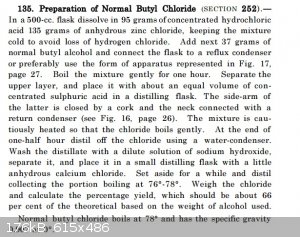 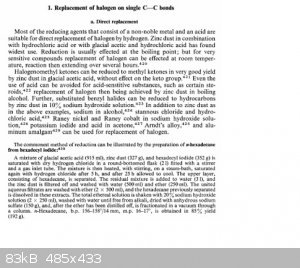
Attachment: lucas reagent.pdf (3.1MB)
This file has been downloaded 55 times
|
|
|
bromosapien
Harmless
Posts: 17
Registered: 2-6-2024
Member Is Offline
|
|
Thank you Alchemica! That material is immensely helpful, exactly what I wanted!
The magnesium method also interests me, but I had the same concerns (I'm also very much "still learning...") because it essentially proceeds through
formation of a Grignard thing, yes? But that is definitely interesting and going directly to my PDF collection for later!
I'm curious what books those are from, and looking for book recommendations for this kind of information - I have no issues finding great educational
material for the theory, but I struggle to find good practical preparatory guides.
|
|
|
bnull
National Hazard
Posts: 998
Registered: 15-1-2024
Location: East Woods
Member Is Offline
Mood: Fecking annoyed
|
|
Take a look at the Library (link below in my signature).
|
|
|
Alchemica
Harmless
Posts: 26
Registered: 31-5-2025
Member Is Offline
Mood: No Mood
|
|
Most welcome. Sorry I saved screenshots that weren't properly referenced my end. Have a feeling the first pic was Norris (see pdf attached), while the
second was Weygand and Hilgetag Preparative Organic Chemistry but that's too big a pdf to attach here. Let me know via message if you have troubles
locating a pdf.
Vogel's Practical Organic Chemistry is definitely one to have on hand, too
Attachment: norris_experimental_organic_chemistry.pdf (1MB)
This file has been downloaded 59 times
|
|
|
bromosapien
Harmless
Posts: 17
Registered: 2-6-2024
Member Is Offline
|
|
Wonderful, thank you guys!
Something I have noticed is that these procedures always seem to call for anhydrous zncl2 even though they involve addition
of aqueous HCl... is that something I really need to pay special attention to?
I may actually be trying reduction of acids to alcohols with Zinc Borohydride (10.1021/jo00121a060), which definitely requires anhydrous ZnCl2 so I'll
be geting / making some anyway. But it's puzzling.
|
|
|
Alchemica
Harmless
Posts: 26
Registered: 31-5-2025
Member Is Offline
Mood: No Mood
|
|
Definitely anhydrous is the way to go, don't want to be diluting your reaction mixture to even lower [H+] and [Cl-] with hydrated ZnCl2. Mixing
anhydrous ZnCl2 with 36% HCl is very exothermic and evolves quite a bit of HCl gas, so ice bath cooling, stirring etc seem important.
I've seen NaBH4/I2 (think THF used as solvent) for simple, high yielding undergrad reductions of amino acids to amino alcohols, so don't neglect that
|
|
|
bromosapien
Harmless
Posts: 17
Registered: 2-6-2024
Member Is Offline
|
|
Hell yes. Thanks for the spoonfeeding-adjacent help, you have saved me so much time and given me a lot of fun reading!!!
|
|
|
Alchemica
Harmless
Posts: 26
Registered: 31-5-2025
Member Is Offline
Mood: No Mood
|
|
All good, happy to help. BTW I find reading e-EROS - The Encyclopedia of Reagents for Organic Synthesis - to be a good start to get some ideas and
further references for whatever reagent you want to utilise
It's detailed information on more than 5,250 reagents and catalysts, and every year up to 200 new or updated articles are added in order to keep the
Database up-to-date. https://onlinelibrary.wiley.com/doi/book/10.1002/047084289X
Don't have a full pdf of it I've been able to locate so I just sci-hub.st the individual reagent articles of interest
Good luck, nothing too nefarious in your organic chemistry projects please.
[Edited on 3-3-2026 by Alchemica]
|
|
|
zed
International Hazard
Posts: 2324
Registered: 6-9-2008
Location: Great State of Jefferson, City of Portland
Member Is Offline
Mood: Semi-repentant Sith Lord
|
|
Seems to me I've seen such a procedure, but it involves replacing that -OH group with Iodine, and reducing the product with Zn.
Of course, the reduction of Ephedrine via HI from I2 and Red Phosphorus, is well known.
But, in that case the -OH to be replaced by H, happens to be placed on a Benzylic Carbon atom. The stability of that particular Carbonium Ion, allows
OH to be replaced by I, and then it allows the I to be replaced by H. This later action being more or less irreversible.
OH may also be removed via Toluene Sulfonyl-Chloride? Under these somewhat unique conditions -OH becomes a good leaving group via hydrogenation.
Problems? The amino group may require protection during the procedure. Expensive, hard to obtain reagents may be required.
|
|
|
bromosapien
Harmless
Posts: 17
Registered: 2-6-2024
Member Is Offline
|
|
Quote: Originally posted by zed  | Seems to me I've seen such a procedure, but it involves replacing that -OH group with Iodine, and reducing the product with Zn.
Of course, the reduction of Ephedrine via HI from I2 and Red Phosphorus, is well known.
But, in that case the -OH to be replaced by H, happens to be placed on a Benzylic Carbon atom. The stability of that particular Carbonium Ion, allows
OH to be replaced by I, and then it allows the I to be replaced by H. This later action being more or less irreversible.
OH may also be removed via Toluene Sulfonyl-Chloride? Under these somewhat unique conditions -OH becomes a good leaving group via hydrogenation.
Problems? The amino group may require protection during the procedure. Expensive, hard to obtain reagents may be required. |
Yeah, even if the Nagai worked I'm not interested in it, I'm really hoping to find a route that only uses Zinc and HCl gas. I also fear the 'amino
alkyl iodide' would be more prone to polymerize or make the aziridine. If I have trouble with HCl I may try with HBr.
|
|
|
clearly_not_atara
International Hazard
Posts: 2927
Registered: 3-11-2013
Member Is Offline
Mood: Big
|
|
I believe a procedure exists using hydrochloric acid with Pd and H2. This would satisfy the conditions but it does of course involve palladium. Unlike
most other metals, Pd is somewhat resistant to oxidation by protons.
|
|
|
bromosapien
Harmless
Posts: 17
Registered: 2-6-2024
Member Is Offline
|
|
| Quote: Originally posted by clearly_not_atara | | I believe a procedure exists using hydrochloric acid with Pd and H2. This would satisfy the conditions but it does of course involve palladium. Unlike
most other metals, Pd is somewhat resistant to oxidation by protons. |
Have you (or has anyone here) experience with Raney Ni? From my reading, you can usually substitute it for pd/c at the cost of yield.
Also - If I understand correctly, alcohol Sn2 with HX proceeds through a carbocation, yes... would this lead to rearrangement in the case of a beta
hydroxyl amine? Which could actually be beneficial if the end goal is to remove the hydroxyl, however, could it then lead to racemization in some
cases?
|
|
|
clearly_not_atara
International Hazard
Posts: 2927
Registered: 3-11-2013
Member Is Offline
Mood: Big
|
|
Raney Ni is not compatible with HCl. It will be attacked. In this case, it can't substitute.
|
|
|



![[*]](images/xpblue/default_icon.gif)


