Ralf
Harmless

Posts: 10
Registered: 21-2-2025
Member Is Offline
|
|
Freezing mixtures - an overview
To achieve low temperatures in the laboratory, so-called freezing mixtures (or frigorific mixtures) are commonly used. In most cases, crushed ice is
mixed with a salt. The salt melts the ice, and the heat of fusion required is drawn from the surroundings, causing the temperature to drop. Before the
refrigerator was invented, this was the only way to achieve temperatures below 0 degrees Celsius regardless of the weather. For this purpose, ice
stored in ice cellars during the winter was used, which was also available in the summer. The best-known freezing mixture consists of one part table
salt and three parts ice. At that time, however, many other mixtures were also investigated. A website lists some of these variants. [1] I found some
of the temperature specifications to be rather adventurous and some mixtures to seem counterintuitive, such as sulfuric acid mixed with ice.
Unfortunately, no sources are cited for these values. Since there is also very little information on these mixtures in recent literature, I tested
some of them myself—preferably those that are supposed to reach a lower temperature than the ice/table salt mixture. The goal was to determine the
lowest achievable temperature of a mixture in standardized experiments and to document the results in a reproducible manner. I present the results and
some application examples of freezing mixtures here.
Equipment
Dewar flask, Styrofoam containers, thermometer (range: -100 °C), thermometer (range: +150 °C), tablespoon, scale, powder funnel, mortar and pestle,
beakers, magnetic stirrer, stir bar, sturdy plastic bag, wooden stick, wooden block, disposable syringe, plastic wrap, filter material, test tubes,
emergency blanket, burner
Chemicals:
Sodium chloride
Ethanol, 94 %
Glycerin
Powdered sugar
Hydrochloric acid, 24 % and 35.5 %
Sulfuric acid, 66.5 %
Phosphoric acid, 85 %
Potassium hydroxide, 85–90 %
Calcium chloride dihydrate
Ammonium chloride
Potassium nitrate
Citric acid monohydrate
Sodium carbonate, anhydrous
Isobutane
Propane
Chlorine
Ammonia
Mercury
Sulfur dioxide
Sodium
Note:
The freezing mixtures can cause frostbite. Work with the toxic gases only under a fume hood or outdoors. The liquefied gases in the ampoules are under
high pressure and must not be opened unless they are cooled.
Procedure:
General Procedure:
Unless otherwise specified, 100 g of dry, loose snow was always placed in a Styrofoam container, then the optimal amount of the second component
(solid or liquid) as specified in the literature was added, and the mixture was stirred with a thermometer until the temperature stopped dropping. The
lowest temperature reached was determined with an accuracy of 1°C. The air temperature and the temperature of all components and equipment during the
experiments was approximately 0 °C.
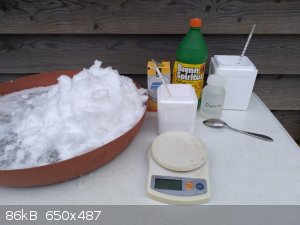
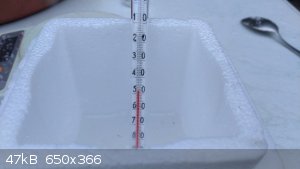
Experimental setup, with the snow supply on the left
The following section describes the experiments and the observations made. Subsequently, some temperature curves are plotted graphically, and the
freezing mixtures are compared in a table.
Sodium chloride: 33 g of table salt was used. The temperature dropped to -21 °C within 2–3 minutes. The mixture consisted of a thick paste. Even
when using granular old snow or crushed ice, I obtained -21 °C in each case, which took just as long. According to the literature, -21.3 °C is
achievable.
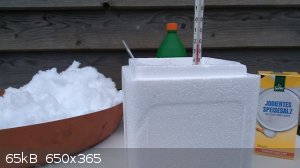
Freezing mixture with table salt
Ethanol: 102 g of denatured alcohol (“at least 94 % ethanol”) was poured in several portions over 100 g of snow. After 3–4 minutes, a
temperature of –31 °C was reached, which is in good agreement with the data provided by Prof. Blume[1] and the original source[2] (–30 °C). The
mixture was very thin. An identical experiment using granular old snow only achieved a temperature of –29 °C.
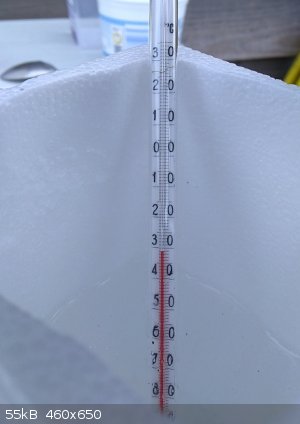
Temperature of the ethanol freezing mixture with fresh snow
Glycerin: In accordance with the literature[3], 33 g of glycerin were added to 100 g of snow. The very viscous, mushy mass reached an average
of -22 °C after 2 minutes, but up to -27 °C in some places. After adding another 23 g of glycerin in two portions, the entire mixture reached -27
°C, which is significantly below the literature value of -20 °C.
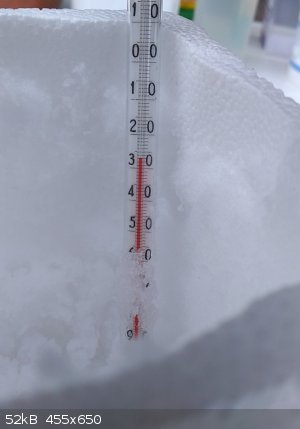
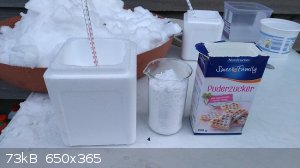
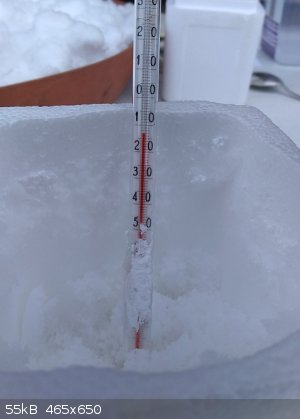
Powdered sugar: A whole range of salts and commercially available substances were tested in freezing mixtures in the 18th an 19th century.
Among them were curious ones like powdered sugar. At a mixing ratio of 1:1, a temperature of -11 °C is said to be achievable.[3] I achieved -13 °C
with a doughy, crumbly mixture of 100 g of snow and 100 g of powdered sugar.
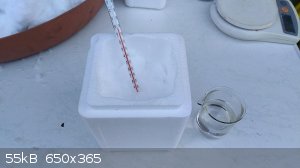
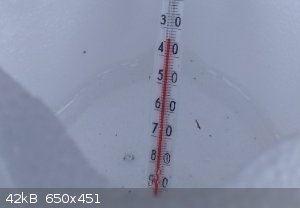
Sulfuric acid: A 1:1 mixture of 66 % sulfuric acid and snow is expected to result in a temperature of -37 °C. [4] Based on my preliminary
tests, a mixture of 110 g of snow with 100 g of 66.5 % sulfuric acid proved to be better. It resulted in a completely liquid mixture with a
temperature of -34 °C. I was unable to achieve lower temperatures with other mixing ratios.
Hydrochloric acid: Pouring 100 g of 35.5 % hydrochloric acid onto 100 g of snow resulted in a temperature drop from 0 to -41 °C in 90
seconds. This is lower than the value reported in the literature (-37.5 °C), for which a slightly more concentrated hydrochloric acid was used. [5]
The mixture was clear and completely liquid. I also tried acid from a hardware store with a 24 % HCl concentration. In a 1:1 mixture with 100 g of
snow, however, the temperature dropped to only -31 °C within 3 minutes. The mixture was a thin slurry and still contained unmelted snow.
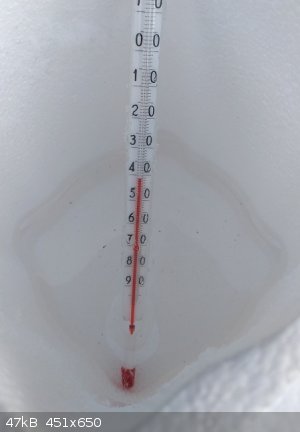
A temperature of -41 °C was reached using concentrated hydrochloric acid...
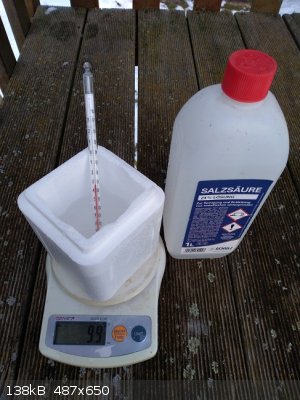
...but only -31 °C with 24 % HCl
Phosphoric acid: Unlike the two previous acids, I could not find any references in the literature for phosphoric acid. Therefore, I created a
series of dilutions starting with 85 % phosphoric acid, adding 50 g of the acid to 50 g of snow in each case. The undiluted acid yielded the lowest
temperature of -30 °C, resulting in a thin slurry. The more the acid was diluted, the less the temperature dropped when mixed with snow. With 60 %
acid, only -20 °C was reached, and the consistency of the mixture was thicker.
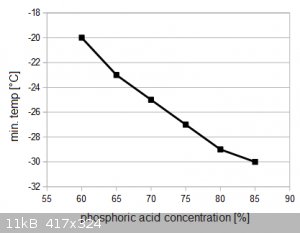
Lowest temperature achieved as a function of the concentration of the phosphoric acid used
Potassium hydroxide: As with acids, one might intuitively assume that mixing potassium hydroxide with ice would cause the temperature to
rise. In fact, however, a mixture of potassium hydroxide and snow is recommended as one of the best freezing mixtures. In the primary literature[6],
the term “crystallized caustic vegetable lye salt” [translated] is used, which apparently refers to potassium hydroxide dihydrate. To obtain this,
I first dissolved 100 g of potassium hydroxide in 64 g of water and allowed it to cool to -1 °C. After a few hours, flat crystals had formed from the
supersaturated solution, starting from a single point, and these were collected. Yield: 87 g.
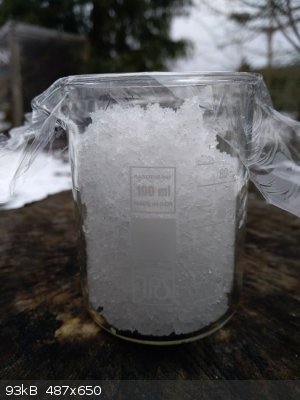
The entire amount was added to 65 g of snow, which, according to the literature, corresponds to the optimal ratio of 4:3.[7] After stirring, the
temperature initially dropped to -47 °C within 4 to 5 minutes. After adding an additional approximately 18 g of snow in two portions, a temperature
of -48 °C was reached.
Potassium hydroxide freezing mixture with snow.jpg
Adding more snow caused the temperature to rise slightly. The optimal ratio was therefore 87 g of potassium hydroxide dihydrate to 83 g of snow. The
lowest temperature remained below the literature value of -55 °C (original source) and -63 °C (Prof. Blume’s website). The second value is likely
not based on actual experiments, but on the physically achievable minimum (freezing point of the concentrated lye).
Calcium chloride hexahydrate: As with the other mixtures, the salt should be used here in a fine-crystalline, dry form to achieve the lowest
temperature. This is hardly possible using standard recrystallization. However, the primary source[8] provides very good instructions on how to
achieve this. I found the following slight modification to be the most advantageous. A concentrated solution of calcium chloride in water is
evaporated while stirring until the solution’s temperature rises to 130–131 °C (increased boiling point due to rising salt concentration).
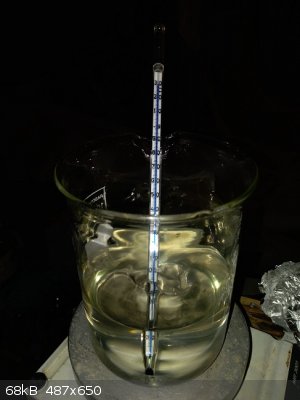
Then let it cool to just above 30 °C and pour the liquid into a sturdy plastic bag, which you seal tightly.
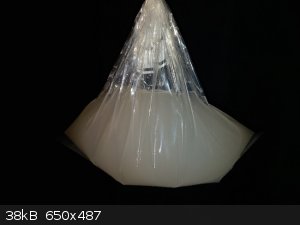
Hold the bag in cold water and knead it gently with your hands until, after a brief period of supersaturation, sudden crystallization occurs. Crush
the resulting clusters of very fine crystals for a few minutes while the bag remains in the water bath. In most cases, this yields a fine, dry
crystalline powder of calcium chloride hexahydrate, which can be transferred to a tightly sealed container. It is very hygroscopic!
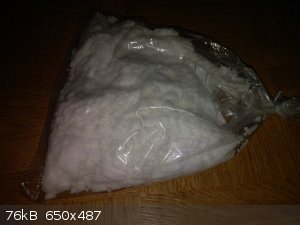
If the crystal slurry still appears liquid after 5 minutes, a lower hydrate has formed (this happens especially if the mixture was heated too high
during concentration), and you must add a seed crystal of calcium chloride hexahydrate and continue mixing the contents as described until they have
cooled completely. When mixed with 100 g of snow, 143 g of this salt hydrate produced a thin slurry with a temperature of -49 °C within 3 minutes. In
a Dewar flask (and thus not comparable to the other experiments), the mixture even reached -50 °C.
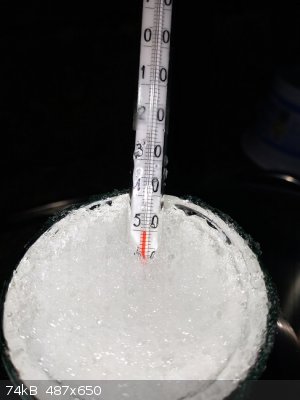
The use of coarser components (larger crystals, granular old snow, or even crushed ice) resulted in temperatures of only -41 to -48 °C.
Potassium nitrate and ammonium chloride: Mixing two salts with snow can result in a lower temperature than using either salt alone. The
number of possible combinations is vast, and information on them often comes from secondary literature, which is prone to errors. I tried only one
variant, which is supposed to yield -31 °C. I ground 13 g of ammonium chloride with 38 g of potassium nitrate in a mortar and added the mixture to
100 g of snow.[9] I obtained a crumbly mass that cooled to only -18 °C starting from -2 °C.
Pre-cooling the components: To achieve particularly low temperatures, especially with acid/snow and ethanol/snow, the components should be
pre-cooled in other freezing mixtures.[10] Because voluminous snow is very poorly suited for this purpose, I pre-cooled only the liquid component in
two experiments. At an air temperature of -10 °C, 102 g of ethanol pre-cooled with an ethanol/snow mixture reached -30 °C. This ethanol was poured
into 50 g of snow cooled to -10 °C. The mixture reached -40 °C (10 °C colder than uncooled ethanol/snow, though in a different mixing ratio). In
this mixture, which was -40 °C, I pre-cooled 100 g of 66.5 % sulfuric acid to -31 °C and added it to 110 g of snow at -10 °C. After stirring, the
mixture reached -45 °C (11 °C colder than uncooled sulfuric acid/snow). The effect of pre-cooling is therefore no greater than would have been
expected from the already cold snow.
I tracked the temperature curves of the mixtures mentioned so far over time. As you can see, the final temperature is usually reached within a few
minutes:
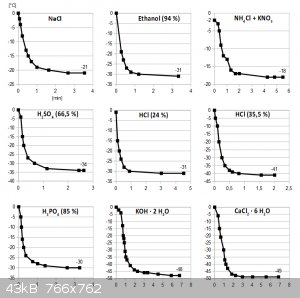
Temperature curves of some of the freezing mixtures described above, each with snow (x-axis: minutes after mixing, y-axis: temperature in °C)
The following examples demonstrate some experiments you can do with freezing mixtures.
Freezing a beaker: Some freezing mixtures work without any ice or snow at all. A well-known example is the mixture of barium hydroxide
octahydrate and ammonium thiocyanate. If the salts are mixed in their solid state, the mixture liquefies and cools so rapidly that the beaker can be
frozen to a damp surface. A few years ago, an alternative to this toxic mixture was developed by mixing sodium carbonate decahydrate with citric
acid.[11] To produce the decahydrate (“crycooling mixturestal soda”) from ordinary sodium carbonate, I dissolved 290 g of anhydrous sodium
carbonate in water and reduced it to a total weight of 875 g. After cooling to 20 °C, a seed crystal of sodium carbonate decahydrate was added and
stirred in an ice bath until 10 °C was reached. The crystals were filtered off, pressed dry, and left to air-dry until they were free-flowing. Yield:
467 g. The product is highly susceptible to weathering and must therefore be stored in a tightly sealed container. To demonstrate the freezing
reaction, a small beaker (100 ml) was placed on a damp piece of wood (200 g), and 11.25 g of finely powdered sodium carbonate decahydrate and 9 g of
finely powdered citric acid monohydrate were stirred inside with a wooden stick. This slowly formed a slimy foam, which quickly collapsed when
stirred.
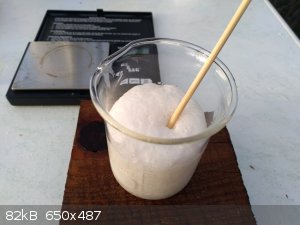
After one minute, the block of wood had frozen to the beaker and could be lifted up with it.
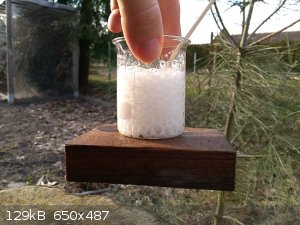
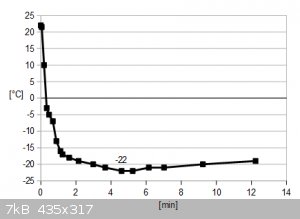
After another 3 to 4 minutes, the ice layer thawed and the piece of wood fell off. To observe the temperature change, in a further experiment, 22.5 g
of sodium carbonate decahydrate and 18 g of citric acid monohydrate, both finely powdered, were mixed in a Styrofoam container. Initially, the
chemicals and objects had a temperature of 22 °C (air temperature). During the experiment, the mixture cooled to -22 °C in 4 to 5 minutes and then
slowly warmed up again.
Making Ice Without a Refrigerator: To produce larger chunks of ice from liquid water in the summer, the previous mixture is not suitable due
to foaming and low heat capacity. Instead, it is better to use a patented crystalline soda/ammonium chloride mixture with water.[12][13] To first
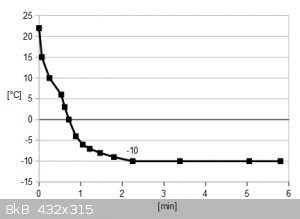
determine the temperature that can be achieved with this, I dissolved a mixture of 50 g of the fine sodium carbonate decahydrate crystals produced in
the previous experiment and 33.3 g of ammonium chloride in 100 ml of water in a Styrofoam container. All components and the container were at 22 °C.
The temperature of the mixture dropped to -10 °C in 2 1/2 minutes, which is within the range of the literature value (according to which the
temperature drop is 31 °C).
To make an ice cube, I filled a Dewar flask with 200 g of water at an air temperature of 20 to 21 °C, added a mixture of 100 g of crystal soda and
66.6 g of ammonium chloride, and stirred.
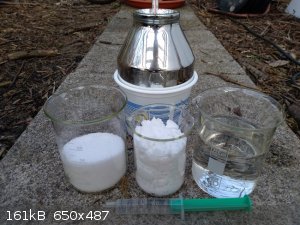
Preparing to make ice in the summer: on the left is crystal soda, next to it is sal ammoniac and water. The water in the syringe is supposed to freeze
in this mixture.
After the salts dissolved, the solution reached -11 °C. A disposable syringe filled with 6 ml of water was placed inside and stirred occasionally.
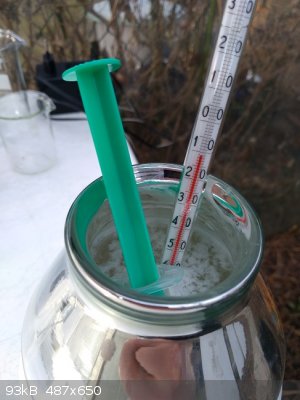
After half an hour, the temperature of the freezing mixture had risen to -8.5 °C. The water in the syringe was completely frozen solid and could be
removed as a piece of ice.
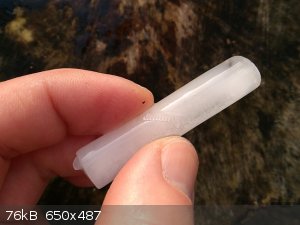
I estimate that with this amount of freezing mixture, one could make five times as much ice—perhaps 30 ml of ice using 167 g of the salt mixture
plus 200 ml of water. Back then, freezing mixtures were far too expensive for making larger quantities of ice.
...to be continued in the next post
|
|
|
Ralf
Harmless
Posts: 10
Registered: 21-2-2025
Member Is Offline
|
|
Liquefying gases: One application of frigorific mixtures is the liquefaction of gases. For example, the temperature of an ice/table salt
mixture (-21 °C) is sufficient to liquefy sulfur dioxide (boiling point: -10 °C). [14] A mixture of calcium chloride hexahydrate and snow can also
be used to condense chlorine (-34.6 °C), ammonia (-33.3 °C), and even propane (-42 °C). To do this, place the container, e.g., a test tube, in the
freezing mixture and feed the corresponding gas into the container via a tube that reaches all the way to the bottom. Occasional stirring improves
heat transfer.
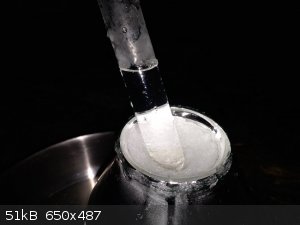
liquefied propane
The liquefied gases can be melted into ampoules with sufficiently thick walls.
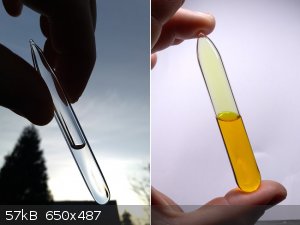
Ammonia on the left, chlorine on the right
Solvated electrons can also be generated by dissolving sodium in liquid ammonia.[15]
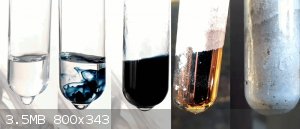
From left to right: liquefied ammonia, dissolution of a piece of sodium, solution with solvated electrons, mirror formation as the ammonia evaporates,
formed sodium amide (white) with excess sodium (silvery and shiny) - click on it to see it move!
Solidifying mercury: Most freezing mixtures were researched in the 18th century. The lower fixed point of the Fahrenheit temperature scale,
for example, is based on a freezing mixture. At that time, it was already known that mercury can freeze due to natural cold. The first successful
attempt to produce this phenomenon using a freezing mixture was made by Josef Adam Braun in December 1754 in Saint Petersburg, when he added nitric
acid to snow. [16] However, the mercury had already cooled to -34 °F (approx. -37 °C) due to the cold weather, which is just above the freezing
point of mercury (-39 °C). Later, calcium chloride hexahydrate[6] and pre-cooled hydrochloric acid mixed with snow were found to be alternatives.[17]
I tried the last method. To do this, 100 ml of 35.5 % hydrochloric acid was pre-cooled in a mixture of 200 g of snow and 200 g of 94 % ethanol...
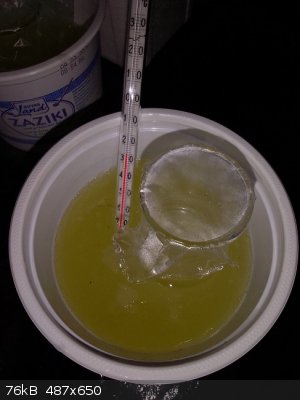
Hydrochloric acid in a cold bath (yellow color due to contaminated ethanol)
...and added to 100 g of snow. Approx. 20 g of mercury was placed in a small beaker inside a plastic bag, poured over with 25 ml of ethanol, and
placed in the HCl/snow mixture. After a few minutes, the excess ethanol reached about -45 °C and the mercury froze completely into a shiny lump.
https://youtu.be/2J_dikAVjW8
The solid mercury is then placed, along with the excess ethanol, into a beaker containing ethanol (at room temperature), where it melts. The ethanol
is intended to prevent the metal and the container from fogging up with water vapor.
Outlook – even lower temperatures:
Using frigorific mixtures, I was unable to go below the -50 °C limit. However, significantly lower temperatures can be achieved by evaporating
liquefied gases. One method involves introducing a liquefied gas and applying a vacuum. A simpler, though less effective, approach is to accelerate
the evaporation of the liquid gas using an air stream. In one experiment, I first liquefied sulfur dioxide using a mixture of ice and table salt. The
liquid SO₂ was then poured over a test tube wrapped in cellulose and containing a small amount of mercury. By blowing into the test tube, the sulfur
dioxide evaporated rapidly.[18] After approximately 10 minutes, a temperature of -43 °C was reached on the outer wall of the test tube, which is
significantly lower than the gas’s boiling point (-10 °C), but higher than the values reported in the literature, which are -50 °C[18] and -57
°C[19], respectively. The mercury in the test tube partially solidified.
https://youtu.be/L_lYcHxjm1w
In a further experiment, I passed air dried over calcium chloride into a test tube containing 20 g of mercury under liquid sulfur dioxide. The end of
the tube was positioned just above the liquid. Here, too, I was only able to reach -43 °C after 10 minutes. More mercury solidified than in the
previous experiment.
https://youtu.be/95fVkgURedg
In the same manner, but without the mercury, I also vaporized isobutane and propane, thereby achieving temperatures below those of the best frigorific
mixtures for the first time. In this process, slightly pre-cooled, dried air was allowed to flow over the liquefied gases. After 10 minutes, I
obtained -54 °C with isobutane and -75 °C with propane.
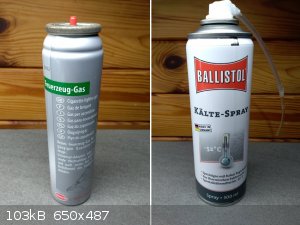
Isobutane (left) and propane (right) in commercially available cans
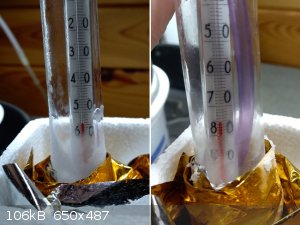
The minimum temperatures reached when passing dry, pre-cooled air through the mixtures (isobutane on the left, propane on the right)
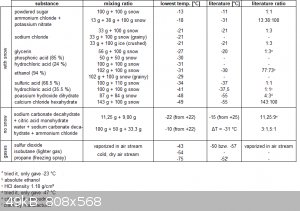
The following table summarizes all the experiments conducted:
Disposal:
Most solutions can be disposed of diluted via the wastewater system. The acids and potassium hydroxide must be neutralized beforehand. The aqueous
ethanol is disposed of with the solvent waste. The mercury is reused. Calcium chloride hexahydrate and sulfuric acid can be recycled by filtering and
concentrating.
Explanation:
In frigorific mixtures, the substances (salts, ethanol, acids) dissolve in the liquid film on the snow crystals. The melting snow extracts the heat of
fusion from the mixture, causing the temperature to drop. Two other phenomena have opposite effects: the heat of dissolution of the salts is also
removed from the surroundings, while the binding of water molecules to the dissolving ions generates heat (enthalpy of hydration). Depending on which
effect is stronger, the temperature drops to a greater or lesser extent. If salts contain crystal water (e.g., CaCl₂·6H₂O or KOH·2H₂O), the
hydration enthalpy decreases because the ions are partially hydrated even before dissolution. This often allows for particularly low temperatures to
be achieved. The temperature decrease is limited by the (lowered) melting point of water, which varies depending on the substance used (melting point
depression). Once this temperature is reached, no more ice can melt and no more salt can dissolve in the meltwater. Entropy can therefore no longer
increase, and the temperature remains constant.
frigorific mixtures can be explained using the Gibbs-Helmholtz equation (ΔG = ΔH - TΔS). When the snow melts or the salts containing water of
crystallization dissolve, the crystal lattices are destroyed and the dissolved ions mix with water molecules. This causes the entropy (ΔS) to
increase. Although the reaction is endothermic (ΔH > 0)—meaning it causes a drop in temperature—the effect of the increase in entropy is
stronger, and the reaction can proceed spontaneously (ΔG < 0).
Passing a stream of air over liquefied gases results in lower temperatures than those achieved through conventional evaporation. This is because the
air mixes with the gas above the liquid, thereby reducing its partial pressure. The liquefied gas is “sucked” into the gas phase and thus
evaporates more rapidly. Heat of vaporization is removed from the system, and the lower the partial pressure of the evaporating gas above the liquid
phase, the lower the temperature drops. The lowest achievable temperature is at the triple point of the gas, which in most cases is just above the
melting point. However, to reach it, a good vacuum is required. From a gas vapor pressure curve, one can determine the temperature that can be
achieved at a specific “vacuum” (i.e., somewhere between 0 and 1 bar).
Discussion:
Some of the values cited in the literature on Prof. Blume’s website are clearly incorrect, such as the magnesium chloride/ice mixture, which, for
physical reasons (freezing point), can reach a maximum of -33.6 °C instead of the stated -94 °C.[20] Other values can apparently be explained by
transcription errors, as in the case of sulfuric acid (°F instead of °C). In this example, the website also failed to note that the alleged -90 °F
(-68 °C) can only be achieved through extensive pre-cooling, if at all.[10] From the list, the “most potent” mixtures remaining are those of
calcium chloride hexahydrate and potassium hydroxide (dihydrate!), each with ice, which also yielded the lowest temperatures in my experiments.
Although the values in the table are lower than those from my experiments, this can be explained by suboptimal conditions (primarily residual water in
the salts).
As a viable alternative to the classic table salt/ice freezing mixture, I would recommend a mixture of snow and 94 % ethanol, which allows one to
achieve a lower temperature (-31 °C) quite cheaply and conveniently. For temperatures down to -50 °C, calcium chloride hexahydrate is also highly
recommended. However, producing the fine-crystalline, dry salt does require a bit of work. It is also important to use snow instead of crushed ice
here. If you want to achieve low temperatures without ice, a mixture of baking soda (decahydrate!), ammonium chloride, and water is a good option. For
demonstrations, I consider a mixture of baking soda (decahydrate) and citric acid to be a suitable substitute for the classic barium
hydroxide/ammonium thiocyanate mixture, for both cost and safety reasons.
The other mixtures are either too corrosive (acids or potassium hydroxide + snow), produce temperatures that are too low (powdered sugar + snow), or
are too expensive. The latter applies, for example, to thiocyanates, which are particularly suitable for achieving low temperatures but still cannot
compete with the inexpensive calcium chloride hexahydrate. The pre-cooling of the components, frequently recommended in the literature—for example,
with the sulfuric acid/snow freezing mixture—did not yield satisfactory results for me.
To achieve temperatures significantly lower than -50 °C, only the evaporation of liquefied gases through reduced (partial) pressure seems promising.
In my experiments, blowing dry air through the system was less effective than allowing air just above the liquid to flow over it. To circumvent the
inevitable heat input from the air, a vacuum can also be applied. This theoretically allows temperatures well below -100 °C to be achieved.
Literature:
[1] Prof. Blumes Tipp des Monats August 1998 (Tipp-Nr. 14) Mit Kältemischungen gibt es auch im Sommer Eis. https://web.archive.org/web/20260221173210/https://www.chemi... archived on February 21, 2026
[2] E. Moritz (1883) Eine neue Kältemischung. Arch. Pharm. Pharm. Med. Chem., 221, p. 211-212
[3] T. Koller (1897) Die Kälte-Industrie. Handbuch der praktischen Verwerthung der Kälte in der Technik und Industrie, p. 386
[4] L. Pfaundler (1875) Über Kältemischungen im Allgemeinen und speciell über jene aus Schnee und Schwefelsäure. Sitzungsberichte der
Mathematisch-Naturwissenschaftlichen Classe der Kaiserlichen Akademie der Wissenschaften, Band 71, Teil 2, pp. 509 -538
[5] A. Ladenburg (1895) Handwörterbuch der Chemie, Band 13, p. 51
[6] T. Lowitz: Versuche über die Hervorbringung von künstlicher Kälte. In: Lorenz von Crell (Hrsg.): Chemische Annalen für die Freunde der
Naturlehre, Arzneygelahrtheit, Haushaltungskunst und Manufakturen. Band 1, Nr. 1. C. G. Fleckeisen, 1796, pp. 529-539
[7] K. Karmarsch und F. Heeren (1880) Karmarsch und Heeren's Technisches Wörterbuch, 3. Aufl., p. 571
[8] H. Hammerl (1878) Über die Kältemischung aus Chlorcalcium und Schnee. Sitzungsberichte der Kaiserlichen Wiener Akademie der Wissenschaften, 78,
pp. 59-79
[9] J. Houben (1925) Die Methoden der organischen Chemie. Erster Band, Allgemeiner Teil, 3 Aufl., p. 1296
[10] T. Pynchon (1871) The Chemical Forces, p. 119-120
[11] J. Kühmstedt (2019) Ein vollwertiger und ungiftiger Ersatz für die Reaktion von Bariumhydroxid mit Ammoniumthiocyanat, CHEMKON, 26, p. 153-157
[12] W. Kausch (1928) Verfahren zur Herstellung einer Kältemischung. Deutsches Reichspatent Nr. 463792
[13] https://web.archive.org/web/20260316000220/https://c.wgr.de/... archived on March 16, 2026
[14] lemmi (2013) Verflüssigung von Schwefeldioxid, https://illumina-chemie.org/viewtopic.php?t=3417, accessed on March 16, 2026
[15] lemmi (2018) Natriumelektrid in flüssigem Ammoniak, https://illumina-chemie.org/viewtopic.php?t=4778, accessed on March 16, 2026
[16] J. F. Blumenbach (1786) Karl Blagdens Geschichte der Versuche über das Gefrieren des Quecksilbers. In: Sammlungen zur Physik und Naturgeschichte
von einigen Liebhabern dieser Wissenschaften, Bd. 3, 2. St., p. 347-383
[17] R. v. Wagner (1877) Jahresberichte über die Leistungen der chemischen Technologie mit besonderer Berücksichtigung der Gewerbestatistik für das
Jahr 1876, Band 22, p. 921
[18] J. Lorscheid (1899) Lehrbuch der anorganischen Chemie mit einem kurzen Grundriß der Mineralogie, 14. Aufl, p. 62
[19] J. Houben (1925) Die Methoden der organischen Chemie. Erster Band, Allgemeiner Teil, 3 Aufl., p. 347
[20] M.V. Achkeeva, N.V. Romanyuk, E.A. Frolova, et al. (2015) Deicing properties of sodium, potassium, magnesium, and calcium chlorides, sodium
formate and salt compositions on their basis. Theoretical Foundations of Chemical Engineering , 49, pp. 481-484
[Edited on 19-3-2026 by Ralf]
|
|
|
Fery
International Hazard
Posts: 1130
Registered: 27-8-2019
Location: Czechoslovakia
Member Is Offline
|
|
Great and very valuable work!!!!! High practical skills!!!!!
The cheapest and most powerful for home use seems to be CaCl2.6H2O. Also interesting conc. HCl (I knew it is quite powerful but couldn't find how much
anymore).
You mentioned it depends on larger crystals, granularity of old snow, or even crushed ice. I usually postpone reactions which require cooling into
winter when fresh snow falls. Then I make a huge pile on the north side of my house where it stays for e.g. 1-2 weeks longer than in garden
(protection from sunshine). Typical winter here looks like snowing for 1 week and then rest of the month the snow slowly melts which repeats like 3-5
times per one winter season. The snow is free, I'm also quite little lazy to crush pieces of ice from freezer and long ago I read that snow is better
than crushed ice due to finer granularity. From your experience - is fresh snow (small granularity) better than old snow (larger crystals) ?
|
|
|
Hexabromobenzene
Hazard to Others
Posts: 263
Registered: 27-4-2021
Member Is Offline
|
|
Magnesium perchlorate will give you -67 degrees, and calcium perchlorate -74
|
|
|
Ralf
Harmless
Posts: 10
Registered: 21-2-2025
Member Is Offline
|
|
Did you or anyone else try this? Sounds interesting! Theoretically, it should work, because these seem to be the eutectic values. With salts I mostly
reached at least nearly the theoretical value (eutectic), but with liquid (e.g. H2SO4, ethanol) it didn't work. To get close to the eutectic point,
liquids have to be precooled far below 0 °C.
With calcium bromide (I would use the hexahydrate) the temperature should even drop down to -83 °C. This would be crazy. I'm planing to make this
salt and try it next winter. It is easier to make for me than perchlorates.
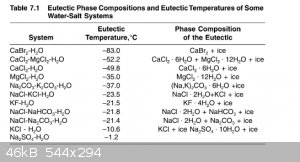
The eutectic ratio is said to be 7.26 mole % of CaBr2. So one should mix 252 grams of CaBr2 * 6H2O with 100 grams of snow to get the lowest
temperature, if I calculated correctly. This is a small amount of snow compared to the salt. Since I believe, that most of the cooling effect comes
from the heat of fusion of the snow, it could be difficult to really get to -83 °C.
There is also still some potential for the KOH * 2H2O (theoretical lowest = -63 °C), because it should be very fine and dry (what I didn't manage to
achieve in my q&d preparation).
Another interesting candidate is lithium chloride (eutectic point: -74 °C). Easy to make.
@Fery: thanks! The fresher and finer the snow, the better! Only for some mixtures, the size of the ice/snow particles didn't make any difference. For
example NaCl. I always got -21 °C. But for the better performing mixtures, the grain size of the snow/ice did play a role! With old snow (grainy
particles) it takes longer to melt the whole ice particle. During this time, heat from the outside of the mixture can enter (or you have to stir very
long which again puts some energy into the system). Additionally, the snow should have a temp below 0 °C, which means it should be "dry".
[Edited on 19-3-2026 by Ralf]
|
|
|
|


![[*]](images/xpblue/default_icon.gif)


