semiconductive
Hazard to Others

Posts: 451
Registered: 12-2-2017
Location: Scappoose Oregon, USA.
Member Is Offline
Mood: Explorative
|
|
Potassium Ferricyanide from ferrocyanide via H₂O₂, NaNO₂
I have a lot of potassium ferrocyanide, yellow crystals, but they are generally too stable to electroplate with in non-aqueous solutions. It's hard
to get it to ionize, and also difficult to get it to separate from water of hydration.
I've been told the ferricyanide is much less stable and doesn't need water of hydration when crystallized.
I assume I can oxidize ferrocyanide to ferricyanide.
Chlorine gas will do it.
But, I didn't have any on hand today, so I tried something different.
If this new idea isn't a good way to go, I can get calcium hypoclhorite and mix it with sodium bisulfite and table salt to produce chlorine gas; but
I'd rather avoid chlorine gas if I can.
Therefore:
I mixed posassium ferrocyanide with water to make a yellow solution. Then I added very weak (1/2 %) hydrogen peroxide. Because --- Nothing appeared
to happen. I then I added sodium nitrite ( about the same amount of crystals, 1 [cc] or so as the ferrocyanide).
Very slowly bubbles began forming, and the solution changed from a pure yellow to a yellow-green color over a period of an hour.
I suspect the reaction worked, although the color isn't red yet.
I hope If I allow this greenish solution to evaporate over a period of days, the color will redden and eventually begin to crystallize.
Am I anywhere close to correct ?? 
I'm not sure if I should expect the sodium nitrite, or peroxy nitrite, or possibly nitrate (if nitrite oxidized), to co-crystalize with the
ferricyanide.
How can I optimize the process to get as much ferricyanide as possible with minimum water crystallization ?
N.B.
There is some mention in the literature that a side reaction might happen, which would replace some cyanide with oxygen-nitrate compounds or possibly
cyaniamide. If this makes the iron cyanide more ionizable, I don't mind. But, I'd rather not have free oxygen able to combine with iron to make
rust.
Thoughts?
|
|
|
semiconductive
Hazard to Others
Posts: 451
Registered: 12-2-2017
Location: Scappoose Oregon, USA.
Member Is Offline
Mood: Explorative
|
|
I suppose sodium percabonate might be less expensive than hydrogen peroxide, although it would make the environment alkaline.
|
|
|
DraconicAcid
International Hazard
Posts: 4509
Registered: 1-2-2013
Location: The tiniest college campus ever....
Member Is Online
Mood: Semi-victorious.
|
|
Quote: Originally posted by semiconductive  |
But, I didn't have any on hand today, so I tried something different.
If this new idea isn't a good way to go, I can get calcium hypoclhorite and mix it with sodium bisulfite and table salt to produce chlorine gas; but
I'd rather avoid chlorine gas if I can.
|
I don't have any experience with ferrocyanides or ferrocyanides, but hypochlorites with react with bisulphAtes to give chlorine gas. With sulphItes
or bisulphItes, you get sulphates and chloride ions.
I'm assuming that's just a typo on your part, but just making sure.
Please remember: "Filtrate" is not a verb.
Write up your lab reports the way your instructor wants them, not the way your ex-instructor wants them.
|
|
|
chempyre235
Hazard to Others
Posts: 219
Registered: 21-10-2024
Location: Between Nb and Tc
Member Is Offline
Mood: Quite distracted
|
|
@Semiconductive, it might be cheaper just to buy it ($23-$36/lb.), unless of course if the goal is the fun of the synthesis, which is great too! 
Anyway, here are a couple of US-based sellers. I haven't vetted all of these, so it's at your own discretion.
https://us.chemicalstore.com/potassium-ferricyani995potassiu...
https://stores.photoformulary.com/potassium-ferricyanide/
https://artcraftchemicals.com/products/potassium-ferricyanid...
"However beautiful the strategy, you should occasionally look at the results." -Winston Churchill
"I weep at the sight of flaming acetic anhydride." -@Madscientist
"...the elements shall melt with fervent heat..." -2 Peter 3:10
|
|
|
j_sum1
Administrator
Posts: 6475
Registered: 4-10-2014
Location: Limbo
Member Is Offline
Mood: Just got through yet another "take this job and shove it" moment.
|
|
Photographic suppliers also sell ferricyanide.
I needed some ferro and had a hard time locating it here in oz. The ferri was easy to find.
|
|
|
semiconductive
Hazard to Others
Posts: 451
Registered: 12-2-2017
Location: Scappoose Oregon, USA.
Member Is Offline
Mood: Explorative
|
|
It's mostly a matter of not wanting to waste what I already bought (and impatience). Yellow prussate is considered dangerous to aquatic life around
here, so I'd need to either burn into nitrogen and CO2, or take it to a hazardous disposal place.
OTOH:
Going from ferric to ferrous state supposedly only takes alakaline conditions and heat. eg: like potassium hydroxide might be enough.
So, it probably does make more sense to buy it in the ferric state in the future.
FYI:
I've let my first attempt sit out for a couple of days but it's not evaporating very fast out of a test tube.
So, I decided to heat it gently and set a filter8 pump blowing a gentle stream of filtered air into the test tube. The water is evaporating
reasonably fast off my sodium nitrite, H₂O₂, and (previously) ferrous mixture.
It's looking quite green now.
I wonder how close to evaporated it will need to be before there is a color change.
Since whether the stuff oxidizes or reduces depends on the alkalinity of the solution; maybe ammonium nitrate, or ammonium chloride, would be
effective in acidifying it to convert it to ferric state with H₂O₂ -- eg: if the nitrite doesn't work.
|
|
|
semiconductive
Hazard to Others
Posts: 451
Registered: 12-2-2017
Location: Scappoose Oregon, USA.
Member Is Offline
Mood: Explorative
|
|
Sigh. Failure.
As the water evaporated the color changed back to yellow, and a more intense yellow than the original Prussian (ferrocyanide) yellow.
I'm thinking that the reason it probably failed is because there are more potassium ions required for the ferrous state, than for the ferric state.
But, I didn't remove any potassium and the excess sodium nitrite that I added can't remove any either. Thus, the excess alkalai metal probably kept
the pH basic.
I'm repeating the experiment with ammonium chloride. The ammonia can be boiled out, which hopefully allows small amounts of potassium ions to be
removed by chloride ions. Then perhaps the hydrogen peroxide can oxidize the ferrous salt to ferric.
Again, there's no obvious color change when I mix peroxide with ferrocyanide. Not even after adding a small amount of ammonium chloride.
|
|
|
semiconductive
Hazard to Others
Posts: 451
Registered: 12-2-2017
Location: Scappoose Oregon, USA.
Member Is Offline
Mood: Explorative
|
|
I'm not sure what I'm doing wrong.
Next attempt, incrementally attempting to change using ammonium chloride.
I mixed yellow prussate crystals with a small amount <10% by volume Ammonium chloride. Then added hydrogen peroxide to dissove it (~<3%).
The result is much the same as before, I get a brighter yellow-green color.
Therefore, I continued to add Ammonium Chloride and dissolve it until I had added around 25% crystals by volume compared to ferrocyanide. It became
brighter yellow, and then the green became much more saturated but otherwise ... still green. It's not turning red, or reddish orange.
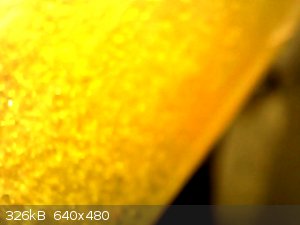
So, I dried it overnight with a gentle air breeze in the test-tube. It mostly dries super bright yellow (more yellow than the original salt) with a
small part on top being yellowish orange. But, all references I see say the solid ought to be "ruby red" -- and it is not.
Mixing it with weak peroxide, again, I added more ammonium chloride. The green starts to go dark, and the more ammonium chloride I add, the darker
the green color is. The solution itself looks almost black, which could be red -- but if it is, then why isn't it drying red rather than turning
orange as it evaporates ?
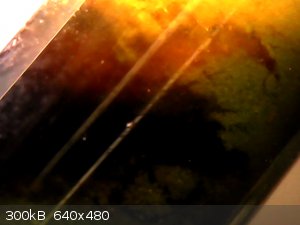
If I had stripped of the potassium, completely, I would be left with prussian blue and that's not what I have. I would need at least dark green for
it to be a mix of prussian blue with ferrocyanide.
I estimate close to 50% by volume is ferrocyanide vs. ammonium chloride, now.
Drying the solution under air causes whitish-yellow crystals to separate out first and fall to the bottom of the test tube, with orange crystals
forming on the test tube walls above the salt. Orange is not ruby red.
The more ammonium chloride I add, the more orange salt appears -- but the yellow stuff is still there. Heating it makes the crystals falling to the
bottom of the test tube become a dark green. I assume that's the onset of prussian blue....
The light orange makes me suspect that I have half yellow, half red, iron cyanides mixed ?
Apparently, it's difficult to drive the reaction to a pure ferric state ?
Online searches don't give me any clues, either.
Anybody have an idea of what I'm doing wrong?
(Besides not buying the ferric already, which I am ordering...)
This is supposed to be an *easy* reaction to do.
[Edited on 27-3-2026 by semiconductive]
|
|
|
semiconductive
Hazard to Others
Posts: 451
Registered: 12-2-2017
Location: Scappoose Oregon, USA.
Member Is Offline
Mood: Explorative
|
|
library has:
https://library.sciencemadness.org/library/books/brauer_ocr....
But the only thing helpful that I see is how to make hexacyanoferric acid. p1510.
That has to be in the ferric state.
Color is yellow when combined with ether -- turns brown when pure.
So, brown and red are pretty close in my book; drying makes the ferric state red or brown.
But my stuff dries orange or green, never red or brown.
Other S.M. library references show how to make cyanide salts from urea, but that's not helpful, here...
I also see another thread with suspiciously similar problems, but no explanation of which shade of green is visible -- and what caused the green:
https://www.sciencemadness.org/talk/viewthread.php?tid=28977
| Quote: |
When I mix the reagents, solution turns green in a matter of minutes. All the manuals tell about cofee color, which is dark-red-brown, while can't see
in no way this color. Next, the solution becomes darker and darker, until I can barely see its color,
|
Doh!
https://library.sciencemadness.org/library/books/the_carbon_...
pp. 54 has some very useful information.
[Edited on 27-3-2026 by semiconductive]
[Edited on 27-3-2026 by semiconductive]
|
|
|
Boffis
International Hazard
Posts: 1929
Registered: 1-5-2011
Member Is Offline
Mood: No Mood
|
|
Hi semiconductive; oxidising ferro and ferricyandes under certain circumstances yields other complex cyanide. The aquopentacyanoferrate III ion is
dark violet -black and is rather unstable and slowly deposits ferric oxide hydrate from solution. If I recall correctly the ferrous analog is yellow
like the hexcyano salt.
I suggest you take a look at the book on cyanide chemistry "Cyanogen compounds" by H E Williams. I thought there was a copy in the Forum library but I
can't see it. I have a hard copy of the 2nd edition but I am sure the first edition is available online for free.
If you can't find it online I'll post it here, the 1st ed is out of copywrite. I can scan any relevant bit from the 2nd if required.
|
|
|
RU_KLO
Hazard to Others
Posts: 320
Registered: 12-10-2022
Location: Argentina
Member Is Offline
|
|
problems with posting....
but:
"Oxygen exerts no action on ferrocyanide of potassium, but
ozone
electric current
bromine
diluted nitric acid
peroxide of lead
manganese dioxide
potassium permanganate
all transform it either wholly or in part into potassium ferricyanide."
page 29. "The Cyanide industry - theoriticallly and practically considered. by R Robine M Lenglen 1906
PLEASE BE CAREFULL - on using acids on ferrocyanide - READ before proceding.
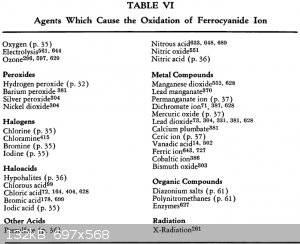
here is a table from bellow:
https://www.911metallurgist.com/blog/ferrocyanides/
[Edited on 27-3-2026 by RU_KLO]
[Edited on 27-3-2026 by RU_KLO]
Go SAFE, because stupidity and bad Luck exist.
|
|
|
semiconductive
Hazard to Others
Posts: 451
Registered: 12-2-2017
Location: Scappoose Oregon, USA.
Member Is Offline
Mood: Explorative
|
|
Indeed. I have avoided using any strong acids.
I have No death wish for people around me.
The 911 metals site notes:
| Quote: | Nitrite. The nitrite ion causes the formation of a bright yellow coloration in ferrocyanide solutions in the presence of acetic acid. This is due to
the formation of the ferricyanide ion and nitric oxide.
ferrocyanide-nitrite
Nitroprusside, [Fe(CN)5NO]-2, is formed from ferrocyanide and acidic nitrite or nitrate solutions on boiling. In the cold, the reaction goes slowly
and incompletely owing to the formation of by-products such as ferric oxide, ferrous ferrocyanides, and the nitritoprusside ion.
|
How strange!
Bright yellow, then, is sometimes ferricyanide and not mixed ferro-ferri cyanides?!
I may have already succeeded if H₂O₂ has the same effect as acetic acid with sodium nitrite.
There's no guideline as to how concentrated the acetic acid is, either, ... but I might try replicating it by slow addition (dropwise) of a weak
solution first, then glacial later (outside with ice).
911met.. also mention no precipitation when mixed with caffiene. But, they don't say if that's because there's no reaction -- or if it forms a salt.

A lot of online references say that Chlorine conversion is not very high yield, but the halogens mentioned by 911metallurigist say "quantitative" even
if slow. eg: A small amount of Iodine will produce ferricyanide + a small amount of prussian blue precipitate. ( But: I'm temporarily out of iodine
crystals. Used them to very effectively kill off a toe nail fungus with tea tree oil / eucalyptis .... )
There seems to be quite a bit of contradiction about what color means what.....
|
|
|
semiconductive
Hazard to Others
Posts: 451
Registered: 12-2-2017
Location: Scappoose Oregon, USA.
Member Is Offline
Mood: Explorative
|
|
| Quote: | | If you can't find it online I'll post it here, the 1st ed is out of copywrite. I can scan any relevant bit from the 2nd if required.
|
I found the first edition online.
In the USA copyright law has a statue of limitations of 75 years. I'm not sure where the S.M. library is hosted. But a second edition printed in
1950 or before is free game as far as I'm concerned in the USA as of 2026.
It's also disconcering to me that the S.M. book I just cited calls ferrocyanide+HCl ferri cyanic acid. But the 911 metallurgist shows a link to
"HydroFerrOcyanic acid" as ferrocyanide+HCl.
[Edited on 27-3-2026 by semiconductive]
|
|
|


![[*]](images/xpblue/default_icon.gif)


