The_BasementChemist
Harmless

Posts: 3
Registered: 27-3-2026
Member Is Offline
Mood: No Mood
|
|
The Impossible search for sulfuric acid in the uk
I am sure as many of you know, the ban on sulfuric acid in the EU and the UK has been a problem for many amateur chemists, as an industrial waste
product required for a number of different reactions is now heavily regulated and almost impossible to get for some.
Recently I have gotten back into doing chemistry and I have had issues obtaining concentrated sulfuric acid. What I have done so far is used the
oxalic acid method (adding copper sulfate to oxalic acid). In my first attempt at this I boiled down the solution (although nowhere near enough which
led to an atrocious yield, however that is not relevant right now and I know how to fix it next time) and prepared for distillation, however it turns
out that under high temperatures the copper oxalate reacts with the sulfuric acid, which lead to oxalic acid being produced again which decomposed
into some nasty fumes. Not only that, but at the end of the distillation there was a dull greyish powder caked to my flask which I presumed to be some
sort copper compound (oxide maybe?), and the only way for me to remove it was to add dilute HCl and turn it into copper chloride, which is really
toxic and I did not like having to clean up and dispose of that, which I did in a painfully slow way by adding aluminum foil (slow because the
reaction is really exothermic so it was bubbling a lot) which then in turn boiled the dilute HCl in the beaker producing more unsavoury fumes.
On my next go I let the solution rest so the copper oxalate could rest at the bottom so i could try and decant as much of the H2SO4 to another beaker
before concentrating it, however there was still that same grey residue left in my flask when I finished my second distillation. Another downside to
this is the fact that oxalic acid solution is expensive as hell as at the time i could only find it as a 9.95% solution. I have since found someone
selling pure oxalic crystals on eBay but still, it’s really expensive (500g is I think £30ish?).
I then went back online to look for literally anything that might contain sulfuric acid and I managed to find this website selling 14% sulfuric acid
(https://www.comls.co.uk/product/25ltr-granudos-acid-14-sulph...), so I bought 50L (my bank account hates me) because I thought that would surely
be enough to last me a good while (its about 7L of pure sulfuric acid). However, I just received an email from them issuing me a refund as apparently
they only sell business to business (even though there is no mention of this on their website, I tried to find something about this but I couldn’t)
so now i’m a bit stuck, as every other website that I have checked with seems adamant on not selling to private individuals.
If anyone has any other way that doesn’t break the bank and is fairly accessible I would appreciate it if you shared.
|
|
|
RU_KLO
Hazard to Others
Posts: 321
Registered: 12-10-2022
Location: Argentina
Member Is Offline
|
|
I would try acid for car batteries, but from a google search:
Battery Acid
Product Code: A1014U
Business customers must provide documents for orders; home users need an EPP License. Must be 18+ to purchase.
I dont know how difficult is to obtain a EPP license in UK.
https://www.gov.uk/government/publications/licensing-for-hom...
listed are :
ammonium nitrate: 16% N
hexamine: regulated at any concentration
hydrochloric acid: 10% w/w
hydrogen peroxide:12% w/w
nitromethane: 30% w/w
nitric acid: 3% w/w
potassium chlorate: 40% w/w
phosphoric acid: 30% w/w
potassium perchlorate: 40% w/w
sodium chlorate: 40% w/w
sodium perchlorate: 40% w/w
sulphuric acid: 15% w/w
Go SAFE, because stupidity and bad Luck exist.
|
|
|
Alkoholvergiftung
Hazard to Others
Posts: 243
Registered: 12-7-2018
Member Is Offline
|
|
I would make H2SO4 per electolysis. If you use coppersulfate you dont need an diaphragma. If you wana make cheaper sulfuric acid you can use
Magnesiumsulfate and an flowerpot diaphragma,optional if you bubble SO2 on the anode side you reduce the polarisation and get higher yields.
|
|
|
j_sum1
Administrator
Posts: 6487
Registered: 4-10-2014
Location: Limbo
Member Is Offline
Mood: Just got through yet another "take this job and shove it" moment.
|
|
Tough.
If you are prepared to boil down, and are already working with copper sulfate, I can recommend flectrolysis. Yes it is slow, but it scales well and if
you can maintain a high enough current then you can do alright. Product is clean - no significant issues with waste or impurities. No membrane
required.
Lead flashing works as an anode - you quickly build up a coating of PbO2. Copper cathode. Copper dendrites form an you can reuse, recycle, or do
whatever you normally do with waste copper.
|
|
|
Fulmen
International Hazard
Posts: 1800
Registered: 24-9-2005
Member Is Offline
Mood: Bored
|
|
I just picked up a second liter of sulfuric acid drain cleaner (not the UK but similar country/regs). After a lot of searching I've found a few
products that were S.A, probably intended for professional use but obviously not everybody will have received that memo. In the end I came across it
at a local garden equipment shop, 40eur/liter. It's called "Sour Power", but that's probably a local name. Searching for drain cleaners and details
like the density=1.8 or pH=0,3 might help, then check the msds for the specifics.
I also bought battery acid from a specialty shop a couple of years ago. I told the seller I was experimenting with rejuvenating deep cycle batteries,
and after chatting about battery chemistry for 5-10 minutes he said "I'm not supposed to do this but you seem to know what you're doing" :-)
We're not banging rocks together here. We know how to put a man back together.
|
|
|
The_BasementChemist
Harmless
Posts: 3
Registered: 27-3-2026
Member Is Offline
Mood: No Mood
|
|
Quote: Originally posted by j_sum1  | Tough.
If you are prepared to boil down, and are already working with copper sulfate, I can recommend flectrolysis. Yes it is slow, but it scales well and if
you can maintain a high enough current then you can do alright. Product is clean - no significant issues with waste or impurities. No membrane
required.
Lead flashing works as an anode - you quickly build up a coating of PbO2. Copper cathode. Copper dendrites form a you can reuse, recycle, or do
whatever you normally do with waste copper. |
Do you have any recommendations for what type of power supply I should use?
|
|
|
clearly_not_atara
International Hazard
Posts: 2931
Registered: 3-11-2013
Member Is Offline
Mood: Big
|
|
I still don't get why people are using expensive and toxic copper sulfate instead of cheap and harmless magnesium sulfate
|
|
|
MadHatter
International Hazard
Posts: 1374
Registered: 9-7-2004
Location: Maine
Member Is Offline
Mood: Enjoying retirement
|
|
Copper Sulfate
Like j_sum1 said electrolysis of CuSO4 is a good route. In industry H2SO4 is
produced as a "waste" acid from copper electroplating. I showed one of my nephews
how to do this. It was a science project he did in high school. I used a 6 volt battery
charger and gouging rods(used in welding) as the electrodes. He was amazed that
deep blue solution of CuSO4 turned colorless as copper was being plated on the
cathode. He asked about the nasty sour smell of the "solution". I explained to him it
was dilute H2SO4. I told him to add a little bit of baking soda and he was surprised
how fast it reacted with acid. He was already familiar with the vinegar and baking
soda reaction.
It's really a shame that people outside of the U.S. have to put up with inane
regulations for fear of terrorists making explosives. I get Rooto sulfuric acid drain
cleaner at the local hardware store for about $15(USD) for a half gallon. It's 93%,
a mean critter, and does an excellent job at clearing drains.
From opening of NCIS New Orleans - It goes a BOOM ! BOOM ! BOOM ! MUHAHAHAHAHAHAHA !
|
|
|
j_sum1
Administrator
Posts: 6487
Registered: 4-10-2014
Location: Limbo
Member Is Offline
Mood: Just got through yet another "take this job and shove it" moment.
|
|
I have a benchtop supply which I can regulate for either voltage or current: tops out at 30V or 10A. It was one of the first big purchases I made and
I did it specifically for making H2SO4. But I figured it would be better to get something that could serve in a wide range of applications.
You could use old desktop PC power supplies. There are tutorials around showing how to configure these for different voltages. Not my area of strength
though.
As for using MgSO4 instead of CuSO4, I have never done it. It should be a lot cheaper, but where I live there is not much in it. A couple of
advantages with copper: you get a colour indicator that helps with monitoring progress. And the copper built up on the cathode is more useful than
magnesium hydroxide. A third advantage is that no membrane is needed – not that a flower pot is terribly difficult to obtain, but CuSO4 gives a
slightly simpler setup.
|
|
|
MadHatter
International Hazard
Posts: 1374
Registered: 9-7-2004
Location: Maine
Member Is Offline
Mood: Enjoying retirement
|
|
Rooto
For U.S. members who are interested:
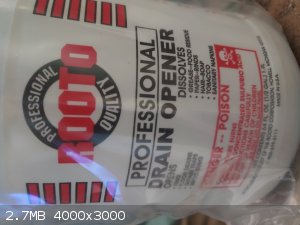
From opening of NCIS New Orleans - It goes a BOOM ! BOOM ! BOOM ! MUHAHAHAHAHAHAHA !
|
|
|
The_BasementChemist
Harmless
Posts: 3
Registered: 27-3-2026
Member Is Offline
Mood: No Mood
|
|
| Quote: Originally posted by j_sum1 |
I have a benchtop supply which I can regulate for either voltage or current: tops out at 30V or 10A. It was one of the first big purchases I made and
I did it specifically for making H2SO4. But I figured it would be better to get something that could serve in a wide range of applications.
You could use old desktop PC power supplies. There are tutorials around showing how to configure these for different voltages. Not my area of strength
though.
As for using MgSO4 instead of CuSO4, I have never done it. It should be a lot cheaper, but where I live there is not much in it. A couple of
advantages with copper: you get a colour indicator that helps with monitoring progress. And the copper built up on the cathode is more useful than
magnesium hydroxide. A third advantage is that no membrane is needed – not that a flower pot is terribly difficult to obtain, but CuSO4 gives a
slightly simpler setup. |
What was your set up cost for this? And how much are you paying for copper sulfate? Somehow I managed to find a website willing to sell to private
persons, and I was planning to get 40L of 14% H2SO4 (which is roughly 5.6L of the acid) which is probably enough to last me a lifetime (I hope).
However it would cost £130, and not to mention the sheer amount of time needed to concentrate that much…
|
|
|
j_sum1
Administrator
Posts: 6487
Registered: 4-10-2014
Location: Limbo
Member Is Offline
Mood: Just got through yet another "take this job and shove it" moment.
|
|
| Quote: Originally posted by The_BasementChemist |
What was your set up cost for this? And how much are you paying for copper sulfate? Somehow I managed to find a website willing to sell to private
persons, and I was planning to get 40L of 14% H2SO4 (which is roughly 5.6L of the acid) which is probably enough to last me a lifetime (I hope).
However it would cost £130, and not to mention the sheer amount of time needed to concentrate that much… |
Yes, time is the big expense.
From memory, the power supply cost $120 aussiebucks from ebay. At the time I had a few PC power supplies but decided that something a bit more
professional and adjustable was worth the cost especially as it would save me hours of tinkering on a project I was not terribly interested in. That
was more than a decade ago and I have not regretted it.
I bought a few kg of CuSO4.5H2O from a pottery supplier. I don't recall the price. I still have a bit of it left.
I can reliably get CuSO4.5H20 from the local hardware store for around $15 per kg. MgSO4.7H2O comes in around $7 per kg. So, cheaper, but not a gimme.
I gave up making my own sulfuric acid after I found a cleaning supply that would sell it – I bought a couple of litres and still have some left. I
also have some from a decommissioned lab.
It sounds like your 14% supply might be a good investment in your circumstances. You do not have to boil it down all at once. And many applications
can cope with dilute acid and/or substitute with NaHSO4.
My inclination would be to set up some dedicated glassware for boiling down the acid and dealing with the fumes, and leave it set up. That way you can
run a batch any time you feel like it
|
|
|
Radiums Lab
Hazard to Others
Posts: 301
Registered: 18-3-2025
Location: India
Member Is Offline
Mood: Experiencing the elegance of science.
|
|
I initially had too many problems in getting some concentrated acid (I mean a lot), but the try was worth it, I initally got a liter from a supplier
who sold me for 18% extra of the initial price.
I used that liter to show an other internet based lab supplier that im "Trust Worthy" to get another 5 liters of it.
You could try electrolysis, it works, and its not that expensive.
Bath salt from your hardware store works great.
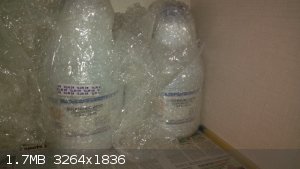
Sorry for the quality, I didn't want to unwrap it. Each can contains 2.5l
[Edited on 7-4-2026 by Radiums Lab]
Water is dangerous if you don't know how to handle it, elemental fluorine (F₂) on the other hand is pretty tame if you know what you are doing.
|
|
|



![[*]](images/xpblue/default_icon.gif)


