| Pages:
1
..
80
81
82 |
HeinzBeans
Harmless

Posts: 6
Registered: 26-2-2023
Location: The blue marble
Member Is Offline
Mood: Drifting
|
|
Thanks for the response Axt and dettoo456, and you where pretty much right in regards to your question about the method of production, I’ll be
following this synthesis;
http://www.sciencemadness.org/talk/viewthread.php?tid=12966
Only difference is that I’ll use potassium nitrate instead. Also vacuum and cryocooling are a little overkill and optional. N2O4 forms at about -10c
so no need for liquid nitrogen temps lol
I have been thinking though, and what do you think about the idea of using Dinitrogen tetroxide + Sulfuric acid as a nitration mix instead of just
N2O4 alone.
Perhaps the Sulfuric acid will act like it does with nitric acid to help form the nitronium ion?
Will also bind to any residual water, though the N2O4 should be anhydrous anyways from this method.
[Edited on 14-5-2025 by HeinzBeans]
|
|
|
dettoo456
Hazard to Others
Posts: 291
Registered: 12-9-2021
Member Is Offline
|
|
I’d only recommend vacuum and strong cooling since I’d be worried that some NO2 would decompose at the high temps involved in the thermal
decomposition. If no vacuum is used, I’d at least try to heavily agitate the melt somehow to ensure the NO2 is stripped and cooled as quickly as
possible. Leading O2 into the off-gas is overkill but could also work if you had a O2 concentrator lying around.
N2O5/H2SO4 is overkill, anhydrous N2O5 will nitrate basically anything.
|
|
|
HeinzBeans
Harmless
Posts: 6
Registered: 26-2-2023
Location: The blue marble
Member Is Offline
Mood: Drifting
|
|
Ok, thank you for the input 
Also when I referred to using Sulfuric acid I meant with the tetroxide not the pentoxide, little spelling mistake on my part.
|
|
|
dettoo456
Hazard to Others
Posts: 291
Registered: 12-9-2021
Member Is Offline
|
|
N2O4 will not nitrate anything really, it’ll nitrosate instead. Like Axt mentioned, you need the NO2- species in solution.
|
|
|
dettoo456
Hazard to Others
Posts: 291
Registered: 12-9-2021
Member Is Offline
|
|
I have seen differing procedural methods, mainly depending on availability, but does anyone here nitrate with <98% H2SO4? Basically in the range of
93-98%? I figure it shouldnt complicate reaction conditions that drastically, but I dont have any practical experience with anything less than 98%. I
mean to use AN with the H2SO4 directly, not with azeo HNO3.
I have a decent amount of 98% from Duda along with some 93% industrial grade stuff, and if blended, Ill end up with approx 95.5%, which to me seems
fine. Id prefer not to distill it if possible.
|
|
|
Microtek
National Hazard
Posts: 992
Registered: 23-9-2002
Member Is Offline
Mood: No Mood
|
|
I have only ever used 96% and that has worked fine for everything from nitric esters to TNT.
|
|
|
dettoo456
Hazard to Others
Posts: 291
Registered: 12-9-2021
Member Is Offline
|
|
Alright, thanks. Ill blend what I have up and just use that.
|
|
|
BoroNar
Harmless
Posts: 11
Registered: 30-5-2025
Member Is Offline
Mood: No Mood
|
|
have problem making
Silver Azide directly via Hydrazine Sulfate/HNO3
Tried this reaction:
http://www.sciencemadness.org/talk/viewthread.php?tid=1987&a...
Same from Astral Chemistry’s video:
“Preparation of hydrazoic acid (azoimid) and silver azide” https://www.youtube.com/watch?v=53BvufurXKA
exactly 1:1 no point to re-write all my steps,
even heating very gently, runaway happens and Noxes are polluting nitrate solution, once I managed to redirect noxes to scrubber but precipitate is
still unusable.
Precipitate is snow white color, powderly. After drying it will not ddt, as shown in video, I use torch and it will just melt that powder and metal
(silver) droplets are formed.
Any ideas or variations of this method are welcome. Sodium nitrite and therefore IPN is not available to me, so I have only this route to have azide.
Thanks
[Edited on 3-8-2025 by BoroNar]
|
|
|
Axt
National Hazard
Posts: 977
Registered: 28-1-2003
Member Is Offline
Mood: No Mood
|
|
I don't know why it's not working for you nor have i tried HNO3 oxidation in this setup. But if you check early in that megathread pg. 3 or 4 I did
test persulphate/H2SO4 and successfully caught HN3 as lead azide. It was of questionable safety so I didn't experiment any further. I posted that H2O2
seems to do the same thing but I cannot remember any of that now.
Silver nitrite has low solubility, if you are passing NO/NO2 into solution this is your likely precipitate.
[Edited on 4-8-2025 by Axt]
|
|
|
UndermineBriarEverglade
Hazard to Self
Posts: 79
Registered: 13-6-2024
Member Is Offline
|
|
Dense nitroguanidine?
Quote: Originally posted by dettoo456  | | NQ is far and away the best option for mixing with ETN, as it’s very powerful on its own, insensitive, and very stable. The only issue is obtaining
the right crystal morphology to select for small particle size and rounded crystal shape. Even so, UN is just too weak and finnicky IMO.
|
What are the usual ways to get high-density nitroguanidine? Are there suitable melt-cast carriers? Can the crystals be wet-ground in a blender? Are
there any solvents that result in better crystals?
|
|
|
Axt
National Hazard
Posts: 977
Registered: 28-1-2003
Member Is Offline
Mood: No Mood
|
|
This is the Chinese method
1 eq NQ
14 eq water with 0.01-0.10 % PVA (poly ~1750)
Boil to dissolve
Adjust pH to 8 with ammonia solution
Under stirring cool 0.1-0.5C per minute to 50C
Rapidly cool from 50C to 20C
Filter, rinse and dry at 65C.
Nominal density increased from 0.16 to 0.8-0.9g/cm3.
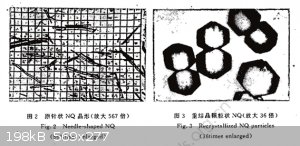
[Edited on 29-8-2025 by Axt]
|
|
|
UndermineBriarEverglade
Hazard to Self
Posts: 79
Registered: 13-6-2024
Member Is Offline
|
|
Thanks. I read about antisolvent recrystallization which promises .94-.97g/cm3 but calls for NMP and more precision. PVA and water looks accessible to the
amateur. Do you have a link to this Chinese paper? I'm not sure how well I can control the rate of cooling with a simple ice bath.
|
|
|
Axt
National Hazard
Posts: 977
Registered: 28-1-2003
Member Is Offline
Mood: No Mood
|
|
It's all in Chinese.
You won't need an ice bath for that slow cooling, you'll need a larger or insulated thermal mass bath. It'd take some experimentation but 1L or 2L
bath heated to boiling then place beaker in it and let it all cool slowly more mass more insulation slower the cooling.
Attachment: High bulk density nitroguanidine (chinese).pdf (1.9MB)
This file has been downloaded 138 times
|
|
|
BoroNar
Harmless
Posts: 11
Registered: 30-5-2025
Member Is Offline
Mood: No Mood
|
|
I have aminoguanidine bicarb batches prepared via reducing nitroguanidine with zinc powder. Synth done exactly per dug's video "Aminoguanidine [small
batch]" all carefully scripted and executed.
One batch I have is white and another is yellow
only difference is that at the end after adding bicarb, accidentally left stirring for hour or so, when came back very fine white precipitate was in
beaker. "Yellow batch" was left overnight to slowly form precipitate.
questions are:
what is "fast white" precipitate, if not AQB then what?
how do amateur can test AQB? what are options for testing and confirmation
Tried burning on alu foil, both "fast white" and "slow yellow" burn with yellow residue. Burn was same for both, same fizzling, fumes and speed.
any idea where that "yellow" comes from? what may be the cause? wanted to recryst, but even in boiling water so tiny powder dissolved, gave up.
|
|
|
Axt
National Hazard
Posts: 977
Registered: 28-1-2003
Member Is Offline
Mood: No Mood
|
|
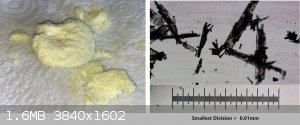
Aminoguanidine bicarb wont "burn" it'll fizz and decompose with considerable white smoke leaving yellow residue but not in a self-sustaining reaction.
If yours is self sustaining its likely partial reduction to nitrosoguanindine, which happens to be yellow. Aminoguanidine will yellow over time
though, even lab acquired will produce a yellow solution.
Attached is my sample of nitrosoguanidine, its recrystallisable from boiling water. Soluble in dilute NaOH which precipitates an energetic silver salt
from AgNO3.
|
|
|
BoroNar
Harmless
Posts: 11
Registered: 30-5-2025
Member Is Offline
Mood: No Mood
|
|
Axt
Thanks for reply,
yes, there was no burn with flames, only fizzing and smoke and foil was heated from bottom with torch.
But residue left is quite large, color is same yellow as on your picture. if nitrosoguanidine was there, it would dissolve in water when I tried to
recryst AQB. I always try to confirm results one way or another, melting point, water solubility, color, etc.. so sad I have no practical way for AQB.
will report back results if these AQB batches have any success in further reactions down the line.
[Edited on 19-10-2025 by BoroNar]
|
|
|
Axt
National Hazard
Posts: 977
Registered: 28-1-2003
Member Is Offline
Mood: No Mood
|
|
Note that nitrosoguanidine wont "burn" with a flame either, just that it's a rapid self-sustaining reaction when touched with a flame. If what you
have is only decomposing when heat is applied, it's likely the bicarb. Just sit a bit underwater and add HCl and see if it fizzes and goes into
solution. Just don't add H2SO4 out of water as that'll make nitrosoguanidine fizz off as well.
The above was made via zinc-NH4Cl reduction of nitroguanidine.
[Edited on 19-10-2025 by Axt]
|
|
|
currawong
Harmless
Posts: 33
Registered: 9-4-2024
Location: Australia
Member Is Offline
|
|
This has probably been asked and answered before, but when setting something off with an impact, is it the shock or the very localised heat generated
that cause it to go off? I have been experimenting with nitrocellulose prepared based on this https://www.sciencemadness.org/smwiki/index.php/Synthesis_of... and I have discovered that if I take a pea sized bit of the guncotton and hit it
with a hammer on concrete, it explodes loudly enough that I probably should have been wearing hearing protection. I haven't tried larger amounts. Is
it the shock or the heat generated that is causing this?
|
|
|
Axt
National Hazard
Posts: 977
Registered: 28-1-2003
Member Is Offline
Mood: No Mood
|
|
The quick answer is adiabatic heating is the primary initiator, but it's a complex question. You could try solvent casting it into a small pellet and
striking that to show the insensitivity created by removing the gas voids. Pressed gun cotton is very sensitive to initiation, but if its solvent cast
into a block (removing the entrapped air) it's practically impossible to detonate.
As mentioned, it’s complex and is reflected in the often poor correlation between impact and friction sensitivities.
|
|
|
KFeNAT
Harmless
Posts: 23
Registered: 27-5-2025
Member Is Offline
Mood: No Mood
|
|
The main factor triggering detonation is the "shock wave" or the forced ignition induced when the shock wave sweeps across the material surface.
Essentially, the propagation of detonation is the propagation of the shock wave itself—striking a hard object with a hammer will generate an intense
"shock wave" at the point of impact.
|
|
|
Axt
National Hazard
Posts: 977
Registered: 28-1-2003
Member Is Offline
Mood: No Mood
|
|
Shock isn't independant of heating, it's either referring to pressure (ie. shock) induced heating or a tribochemical reaction where the pressure if
essentially squishing or shearing the crystal/molecule itself. Although instinctually one tends to favour the later and I don't think there is any
definite answer as its likely a combination effect, but the studies and in practice show that bubble/hot spot sensitisation is the driving factor.
Attachment: initiation-of-solid-explosives-by-impact-and-friction-the-influe-1949.pdf (553kB)
This file has been downloaded 65 times
|
|
|
UndermineBriarEverglade
Hazard to Self
Posts: 79
Registered: 13-6-2024
Member Is Offline
|
|
High-density NQ compositions or derivatives?
Synthesized some nitroguanidine. I plan to recrystallize with PVA for 0.8-1.1g/cm3 (thanks Axt) but even at that density the performance of
nitroguanidine is not that good compared to max density 1.7g/cm3. How can I improve its performance while retaining the insensitivity and
stability? I also have access to ETN and urea nitrate.
Are any NQ derivatives suitable? ANQN tends to weep nitric acid. Has anyone here made PrNQ?
Eutectic mixes of NQ with nitrate salts all seem to be hygroscopic.
There are many experimental TNT melt-cast alternatives, but are any accessible to the amateur? Sir_Gawain reports that NQ doesn't dissolve in ETN. I'd need to buy a lot of stuff to make DNAN. TNAZ is harder to make than TNT. ADN is hygroscopic and
tricky to melt without decomposition.
Hey Buddy found that the extremely hygroscopic AspNO3 melts NQ, and then can be dissolved away by cold water to leave behind very high-density NQ
of 1.4-5 g/cm3. Has anyone else verified this? Why would NQ dissolve in AspNO3, and could it work with a different nitrate,
plain aspartic acid, or other solvents?
|
|
|
KFeNAT
Harmless
Posts: 23
Registered: 27-5-2025
Member Is Offline
Mood: No Mood
|
|
| Quote: Originally posted by UndermineBriarEverglade | Synthesized some nitroguanidine. I plan to recrystallize with PVA for 0.8-1.1g/cm3 (thanks Axt) but even at that density the performance of
nitroguanidine is not that good compared to max density 1.7g/cm3. How can I improve its performance while retaining the insensitivity and
stability? I also have access to ETN and urea nitrate.
Are any NQ derivatives suitable? ANQN tends to weep nitric acid. Has anyone here made PrNQ?
Eutectic mixes of NQ with nitrate salts all seem to be hygroscopic.
There are many experimental TNT melt-cast alternatives, but are any accessible to the amateur? Sir_Gawain reports that NQ doesn't dissolve in ETN. I'd need to buy a lot of stuff to make DNAN. TNAZ is harder to make than TNT. ADN is hygroscopic and
tricky to melt without decomposition.
Hey Buddy found that the extremely hygroscopic AspNO3 melts NQ, and then can be dissolved away by cold water to leave behind very high-density NQ
of 1.4-5 g/cm3. Has anyone else verified this? Why would NQ dissolve in AspNO3, and could it work with a different nitrate,
plain aspartic acid, or other solvents?
|
As an alternative to TNT for amateur casting, 2,4-Dinitrophenoxyethyl nitrate could be tried. It is said to have a melting point of about 64 degrees
Celsius and can be prepared simply by nitrifying Phenoxyethanol with mixed acid at low temperatures.
|
|
|
UndermineBriarEverglade
Hazard to Self
Posts: 79
Registered: 13-6-2024
Member Is Offline
|
|
| Quote: Originally posted by Axt | It's all in Chinese.
You won't need an ice bath for that slow cooling, you'll need a larger or insulated thermal mass bath. It'd take some experimentation but 1L or 2L
bath heated to boiling then place beaker in it and let it all cool slowly more mass more insulation slower the cooling. |
Tried the Chinese method on a small scale but without a temperature-controlled hot plate I wasn't able to cool it slowly enough. With the right
equipment or on a larger scale it seems very doable. Even though my temperature dropped at least 10x faster than specified, there was still an obvious
density improvement. Thanks.
[Edited on 2026-1-6 by UndermineBriarEverglade]
|
|
|
BoroNar
Harmless
Posts: 11
Registered: 30-5-2025
Member Is Offline
Mood: No Mood
|
|
| Quote: Originally posted by BoroNar | I have aminoguanidine bicarb batches prepared via reducing nitroguanidine with zinc powder. Synth done exactly per dug's video "Aminoguanidine [small
batch]" all carefully scripted and executed.
One batch I have is white and another is yellow
only difference is that at the end after adding bicarb, accidentally left stirring for hour or so, when came back very fine white precipitate was in
beaker. "Yellow batch" was left overnight to slowly form precipitate.
questions are:
what is "fast white" precipitate, if not AQB then what?
how do amateur can test AQB? what are options for testing and confirmation
Tried burning on alu foil, both "fast white" and "slow yellow" burn with yellow residue. Burn was same for both, same fizzling, fumes and speed.
any idea where that "yellow" comes from? what may be the cause? wanted to recryst, but even in boiling water so tiny powder dissolved, gave up.
|
answering to my own question:
it turns out both "fast" and "slow" precipitated are both aqb and work as any other aqb obtained in other synths.
Densities differ, crystalls are different both visual and handling, but work in uNAP synth.
Can't say which precipitate is better yelding, since uNAP synth is still hit, half hit and miss every time for me... randomly getting yelds from 10%
to 45% from AQB used.
|
|
|
| Pages:
1
..
80
81
82 |


![[*]](images/xpblue/default_icon.gif)


