4-Stroke
Hazard to Self

Posts: 61
Registered: 20-4-2024
Location: Canada
Member Is Offline
Mood: Often Wrong, Never Unsure
|
|
DIY Ethylene Plant
Hello everyone. I was wondering if it is possible for an amateur to construct an ethylene "furnace" similar to this:
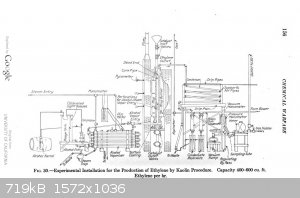
I would use alumina as the catalyst instead of kaolin as it is not significantly more expensive, has a longer lifespan, has a uniform size (thus is
easier to work with), and I think it is more effective (less of it is needed compared to kaolin to generate ethylene at the same rate).
Heating the catalyst tube horizontally should be much easier than vertically.
Also, instead of the condenser, I think that it should be much easier to bubble the resulting ethylene/hydrogen/ethanol/steam/ether mixture into a
large container with water (that is either just kept as is for short runs, cooled externally, or just continuously feed into the container to keep it
cool).
Something like this:
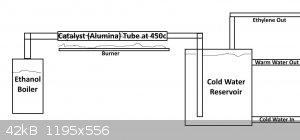
The "reactor" should consist of:
1. An airtight container where ethanol is boiled (e.g. a 5 gallon steel bucket with an airtight lid. Normal silicone could be used to ensure
airtightness as ethanol boils at a low temperature).
2. A steel pipe that leads the ethanol vapors to the catalyst tube (e.g. a 1" threaded pipe which is insulated to prevent ethanol reflux).
3. A steel tube filled with alumina catalyst (e.g. a 1.25" threaded tube, about a meter long, heated to 450°C).
4. A propane burner underneath the catalyst tube.
5. A tube that leads the products to the bottom of an airtight container (e.g. 30 or 55 gallon drum) filled with water to cool the gasses.
6. The gasses, when cooled, result in water, ether, and unreacted ethanol mixing with the water, while the ethylene and hydrogen bubble out.
7. The output tube leads the produced ethylene out of the container.
8. The water-filled container either:
-Has cold water inputted at the bottom and removed closer to the top.
-Is submerged into a larger container that has cold water circulation (e.g. a 30 gallon drum inside a 55 gallon drum).
-Is left uncooled (for shorter runs).
This would significantly simplify the system as most of it is dedicated to either vaporizing ethanol and mixing it with steam or condensing the gasses
and separating ethylene from them (only the very middle is where the reaction actually takes place), but considering that ethylene is insoluble in
water, wouldn't it just be easier to pass it through water instead of condensing the water out of it? What kind of output (m3 of ethylene
per hour) could be expected?
Thanks.
Ukrainium
|
|
|
Rainwater
National Hazard
Posts: 993
Registered: 22-12-2021
Member Is Offline
Mood: Break'n glass & kick'n a's
|
|
https://youtu.be/zRrgvYJ8gAY?si=yuaZd8tqIb-zPOjy
"You can't do that" - challenge accepted
|
|
|
Varungh
Hazard to Self
Posts: 70
Registered: 23-6-2025
Location: India
Member Is Offline
Mood: Bad mood
|
|
Wouldn't it be much, much easier to make CaC2 using caarbon and CaO? Much easier and cheaper than whatever this is.
It will take a few thousand degrees.
Then make C2H2 from it.then hydrogenate it
Otherwise make a hi temp furnace to make OLEUM OR SO3.these work better than H2SO4 for dehydrating ethanol
Or you can buy ethylene, as some refrigerant. Should not be too expensive. Only if you need small quantities of ultrapure gas though.
[Edited on 10-2-2026 by Varungh]
|
|
|
chempyre235
Hazard to Others
Posts: 207
Registered: 21-10-2024
Location: Between Nb and Tc
Member Is Offline
Mood: Quite distracted
|
|
Quote: Originally posted by Varungh  | Wouldn't it be much, much easier to make CaC2 using caarbon and CaO? Much easier and cheaper than whatever this is.
It will take a few thousand degrees.
Then make C2H2 from it.then hydrogenate it
Otherwise make a hi temp furnace to make OLEUM OR SO3.these work better than H2SO4 for dehydrating ethanol
Or you can buy ethylene, as some refrigerant. Should not be too expensive. Only if you need small quantities of ultrapure gas though.
[Edited on 10-2-2026 by Varungh] |
I'm not sure any setup requiring thousands of degrees will be easier, particularly on a small scale. Besides, the catalysts required for partial
hydrogenation, IIRC, are restrictively expensive. The oleum dehydration could work, but its use tends to limit the materials you can use, especially
in the presence of water, as this would be. Additionally, @4-Stroke's method has the advantage in that it permits a continuous-flow setup. Such a
setup would be nearly impossible to do with CaC2, and very difficult with oleum.
"However beautiful the strategy, you should occasionally look at the results." -Winston Churchill
"I weep at the sight of flaming acetic anhydride." -@Madscientist
"...the elements shall melt with fervent heat..." -2 Peter 3:10
|
|
|
MrDoctor
Hazard to Others
Posts: 249
Registered: 5-7-2022
Member Is Offline
|
|
they seem to be being sarcastic and forgot to make their point, or actual suggestion, beyond posting the top industrial method listed on wikipedia.
i forget if hyperspace pirate used injection-molding band heaters, but you can just use those. also, you probably dont want to go the full 450C,
otherwise you will end up with some hydrogen and carbon monoxide in the mix which is vastly more difficult to remove than if you run it on the low
side so byproducts are just diethyl ether and some ethanol. those you can remove just using a cold trap or icy cold condenser.
this design you have however has a fatal flaw, which is you cannot directly connect a boiler to a bubbler, in the event power is cut or even just
fluctuates hard enough, you will get suckback and pull water into the reactor tube. So youll need a carrier to force positive flow, and given how
incredibly explosive ether and ethylene are, it cant be air or CO2. my personal prefference is to use extremely low-flow argon and a water column
bubbler on the exhaust output, and suck exhausts when they arent problematic, back to the reaction mixture and basically cause faster circulation than
the formation of gas alone would, and my argon is there to dilute anything problematic, as well as provide a bare minimum supply of flow to ensure the
bubbler never backflows. the bubbler is tall and volumous enough that some amount of back pressure is maintained and air is never accidentally sucked
back in. this is more useful for pyrolysis where the pyrolysis products refluxing in the chamber causes further degradation, but it is still useful if
you need to recycle your exhaust gas as a carrier without the risk of outside air entering the lines and/or recycling expensive inert gas like argon
or nitrogen welding gas. the use of the pump running in in a circle between the front and end of your condenser also makes it viable to use a really
big, high resistance graham spiral condenser, although in your case you shouldnt because the vast majority of your product is gaseous.
using oleum/sulfuric acid works, but very quickly leads to the buildup of tar and the loss of sulfate in the form of carcinogenic ethyl sulfate.
it may be worth researching wether polyphosphoric acid is a strong enough dehydrating agent, because it can dehydrate sulfuric acid to oleum, and i
have seen once something written about it being on a silica-substrate (its kinda gooey as it hydrates) being used to make ethers from other alcohols.
at very least it should allow the use of a small amount of sulfuric acid to be used and regenerated in situ. polyphosphoric acid can be regenerated
easily from 100% or high conc phosphoric acid by boiling it down to a glassy consistency in a red hot vessel, which can just be steel electroplated
with copper, replated each time. the presence of the copper wont influence this reaction and its very little anyway, barely enough to put a hole in a
sub-millimeter liner. a cheap induction heater would be great for this but a blowtorch will work just the same.
the only issue here is i dont know how the reaction would proceed, like if its just dripping acid into a very hot reaction vessel so it dehydrates
straight to ethylene, or if it is loaded onto pumice or something in a reaction tube, in which case its going to drip out liquid phosphoric acid, but
if it can work just to regenerate sulfuric acid in situ then it would pretty much just be the oleum method but as a slurry. youll need to research
this yourself because im just making assumptions here, i only know it is a reaction that exists, if its from a patent then all bets are off as far as
desktop setups go.
|
|
|
chempyre235
Hazard to Others
Posts: 207
Registered: 21-10-2024
Location: Between Nb and Tc
Member Is Offline
Mood: Quite distracted
|
|
A lot of good information here, @MrDoctor. Would it be easier to just add a check valve toward the cold end of the bubbler, instead of an argon feed,
or is there something else I'm missing?
"However beautiful the strategy, you should occasionally look at the results." -Winston Churchill
"I weep at the sight of flaming acetic anhydride." -@Madscientist
"...the elements shall melt with fervent heat..." -2 Peter 3:10
|
|
|
Mateo_swe
National Hazard
Posts: 590
Registered: 24-8-2019
Location: Within EU
Member Is Offline
|
|
I dont want to be a break on experimentation but even though some of these ideas could work are you sure you want to experiment with very hot
extremely explosive gases?
Something is sure to fail sometime during the construction or during usage of such device and hot diethyl ether/ethylene gas is very dangerous.
Or very dangerous is not the right word, it much more dangerous than that, be very careful.
Why dont you just buy the ethylene gas if you need some for an experiment?
It might be a bit expensive but it seems much better option, or do you need a lot of it?
What you want to use it for?
|
|
|
leau
Hazard to Others
Posts: 127
Registered: 3-12-2021
Member Is Offline
|
|
This reaction has been studied and published often by professional chemists but is quite dangerous for an amateur that doesn't have a proper
laboratory or equipment  The phenomenon mentioned involving vacuum can injure or
kill people quite easily The phenomenon mentioned involving vacuum can injure or
kill people quite easily  The end results from the effort applied The end results from the effort applied 
Attachment: catalysts-13-00994.pdf (5.4MB)
This file has been downloaded 25 times
Attachment: la+al+etoh+subm.pdf (1.5MB)
This file has been downloaded 23 times
|
|
|



![[*]](images/xpblue/default_icon.gif)


