Keras
International Hazard

Posts: 1143
Registered: 20-8-2018
Location: (48, 2)
Member Is Offline
|
|
Water drops condensing inside the walls of a vacuum desiccator?
Hi folks,
yesterday I was making some anthranilic acid by the classical Hofmann rearrangement (in order to make indigo. So far, I've failed to get any
substantial yield, so I’m redoing it again from scratch). By the way, following Vogel, I was quite pleased to get 10.7 g of anthranilic acid after
recrystallisation, where the textbook calls for 14. Given the conditions I worked with (especially I had not enough ice to properly cool the
hypobromite solution), I think it’s not such a bad result.
Anyway. I scooped my anthranilic acid crystals into a dish, the dish into my vacuum desiccator over calcium chloride and move the vacuum desiccator on
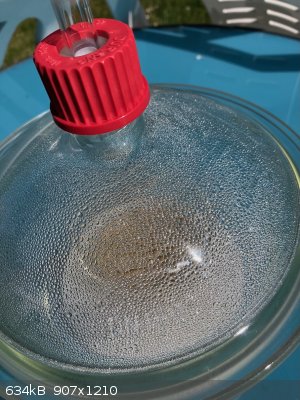
to a sunny window sill, knowing it would be a hot and sunny day. And I was a bit baffled to see big water drops condensing on the inside of the
desiccator's lid. More puzzling, the drops appeared on the side that was directly sunlit, which I assumed was the warmest. At some point I decided to
break the vacuum and wipe the lid with paper towel before re-vacuuming. Matter of fact, the product was totally dry after 4/5 hours.
But my question is: is water expected to condense on the lids of a vacuum desiccator? What physical process can cause the water to condense on the
warmest part? That feels a bit weird to me…
[EDIT: Picture]
[Edited on 31-5-2025 by Keras]
|
|
|
bnull
National Hazard
Posts: 993
Registered: 15-1-2024
Location: East Woods
Member Is Online
Mood: Fecking annoyed
|
|
It may look the warmest side for you, but for glass it is only the side with more radiation and glass absorbs very little infrared. You must also
consider the air circulation around the desiccator.
|
|
|
Keras
International Hazard
Posts: 1143
Registered: 20-8-2018
Location: (48, 2)
Member Is Offline
|
|
Quote: Originally posted by bnull  | | It may look the warmest side for you, but for glass it is only the side with more radiation and glass absorbs very little infrared. You must also
consider the air circulation around the desiccator. |
In fact I found the anthranilic acid to be quite warmer than the glass. It still doesn’t explain why most of the water condensed on the sunny side.
That being said, it was nice: that amount of water didn't contaminate the underlying calcium chloride. Which led me to another question: could this
also be water released by the calcium chloride pellets?
|
|
|
BromicAcid
International Hazard
Posts: 3323
Registered: 13-7-2003
Location: Wisconsin
Member Is Offline
Mood: Rock n' Roll
|
|
100% This could be water released by calcium chloride pellets if they are not anhydrous. That was my first thought.
|
|
|



![[*]](images/xpblue/default_icon.gif)


