chemodis
Harmless

Posts: 9
Registered: 27-8-2025
Member Is Offline
|
|
Cu(I) salt solubility and stability, and the synthesis of cuprous thiocyanate CuSCN
stability of +2/+1 oxidation states of copper
Most cuprous salts with conventional anions like chloride, hydroxide, sulfate, or nitrate are either sparingly soluble in water, or unstable and prone
to disproportionation. This complicates wet chemistry with Cu(I) and is the reason why it caught my interest. Copper usually prefers the oxidation
state +2 over +1, but there are exceptions, commonly with soft ligands. cuprous iodide is a prime example, when a Cu(II) solution is treated with
iodide, it is immediately reduced to Cu(I), oxidizing iodide to iodine. Looking at the redox potentials of Cu2+/Cu+ and I2/I- this is unusual
behaviour, Cu2+ shouldn’t be able to oxidize iodide. The driving force for why it does in fact work, is the (in)stability of the two potential
products. There are ion combinations that are stable in both oxidation states, like the oxide, hydroxide and chloride, but these Cu(I) compounds are
prone to oxidation, especially when wet.
CuSCN lies in between. Cu(SCN)2 exists, but slowly disproportionates to CuSCN and (SCN)2 (edit: not actually disproportionation, more like
intramolecular redox reaction). If one wants to prepare CuSCN from a Cu(II) solution without formation of dithiocyanogen, a reducing agent like
sulfite or a reducing sugar like glucose should be used.
Alternatively, if you happen to have some Cu(I) compound, you could start from there. This is what I cover in the following.
CuSCN and complexation of Cu(I)
CuSCN is practically insoluble in water and cannot be effectively made by action of HSCN on Cu2O due to passivation. Also HSCN is unstable at a
concentration of more than 5% mass, so this would not work well either way. Precipitation is the only option, either from a Cu(II) solution under
reducing conditions, or from a Cu(I) solution that is kept stable by a suitable complexing agent. Because I have some cuprous oxide that has yet to
find a purpose, I decided to experiment with Cu(I) complexing agents. I have tested different chloride salts and ammonia, thiosulfate is on my list as
soon as I have some. Because Cu+ solubility is dependent on the concentration of the complexing agent, I started testing with (highly soluble) CaCl2.
A saturated NaCl solution has a lower chloride concentration but works good anyways. KCl did not work well, as I learned later it forms a double salt
with CuCl, which precipitates way below KCl saturation concentration. I couldn’t get ammonia to dissolve reasonable amounts of Cu2O, more testing
with fresh ammonia is needed. Table salt seems to be the most attractive candidate here. Simply add HCl and a saturated NaCl solution to Cu2O, stir it
until everything dissolves into a clear, brown solution, add some sulfite for a longer shelf life, and you’re done! Add a thiocyanate salt solution
and CuSCN quickly precipitates.
I documented the process in the following. This is not really a recipe to make CuSCN, I didn’t optimise the amount of saltwater I actually need, I
simply used all I made. You could propably get away with less. Not everything ran smoothly, I had a hard time suspending all Cu2O, some clumps just
did not want to get wet. sieving the oxide beforehand and using an acid-compatible surfactant should help.
CuSCN synthesis starting from Cu2O
Chemicals:
75 g Cu2O (slight stochiometric excess)
120 ml 33% HCl (~20% excess)
82 g NH4SCN
one teaspoon of sodium metabisulfite
deionised water
650 ml saturated NaCl solution (room temperature)
dissolving Cu2O
...in HCl is quite exothermic, to prevent the loss of HCl vapours I added 120 ml 33% HCl into a 1000 ml glass beaker and diluted it with 200 ml of
saltwater, this should also improve dissolution of the cuprous oxide because of immediate complexation of any formed CuCl. After that, I added Cu2O,
until nothing more dissolved. Half a teaspoon of sodium metabisulfite were added afterwards to reduce oxidation by air. Another 200 ml saltwater were
added, and the solution was heated until steaming hot. Solubility of chloridocuprate(I) complexes increases significantly with an increase in
temperature, see the attached file. All Cu2O that was left was added to the solution, stirred well until most dissolved. Again, 200 ml of saltwater
were added and the solution heated to steaming. All Cu2O had dissolved and formed a brown solution. Unfortunately, some dark flocs had formed, that
did not dissolve. I believe this had to do with the (dry) heating of Cu2O clumps that stuck to the glass above the solution surface.
  
CuSCN precipitation and collection
The solution was left to cool to around 55°C to prevent thiourea formation when added to NH4SCN. After that it was gravity filtered directly into 82
g NH4SCN dissolved into 80 ml Water. The solution turned pink, likely due to some thiocyanate complexes. With more Cu+ solution running through the
filter paper, white CuSCN precipitates, forming an opaque suspension. Sometime during the precipitation, I added another half a teaspoon of sodium
metabisulfite.
The product was collected by vacuum filtration, washed once with 50 ml saltwater, and three times with 45 ml deionised water.
Dried until a constant mass was achieved, 127.8 g CuSCN were obtained, corresponding to a 97.5 % yield.
  
  
All images with comments: https://imgur.com/a/cuscn-synthesis-8dAW2TG
Attachment: CuCl complex solubility.pdf (303kB)
This file has been downloaded 89 times
[Edited on 4-9-2025 by chemodis]
|
|
|
DraconicAcid
International Hazard
Posts: 4503
Registered: 1-2-2013
Location: The tiniest college campus ever....
Member Is Offline
Mood: Semi-victorious.
|
|
I think one of my books has instructions for the precipitation of CuSCN for use in gravimetric analysis. I'll look for it when I get home.
Please remember: "Filtrate" is not a verb.
Write up your lab reports the way your instructor wants them, not the way your ex-instructor wants them.
|
|
|
teodor
International Hazard
Posts: 1169
Registered: 28-6-2019
Location: Netherlands
Member Is Offline
|
|
Welcome to the board!
This is the nice post, but I can't see the images in the messages.
By SM rules it is always required to provide source of the information you report, you can read the reason for this rule here: https://www.sciencemadness.org/talk/viewthread.php?tid=19143 . When you do, the topic is much easier to discuss for people who didn't perform your
experiment yet.
Also, as far as I know some Cu(II) compounds disproportionate to Cu(I), for example 2CuI2 -> 2 CuI + I2. So, please provide something to read and
understand what you are writing about as a general rule of Cu(I) instability, just to be on the same page.
[Edited on 3-9-2025 by teodor]
|
|
|
DraconicAcid
International Hazard
Posts: 4503
Registered: 1-2-2013
Location: The tiniest college campus ever....
Member Is Offline
Mood: Semi-victorious.
|
|
Quote: Originally posted by teodor  | Welcome to the board!
This is the nice post, but I can't see the images in the messages.
By SM rules it is always required to provide source of the information you report, you can read the reason for this rule here: https://www.sciencemadness.org/talk/viewthread.php?tid=19143 . When you do, the topic is much easier to discuss for people who didn't perform your
experiment yet.
Also, as far as I know some Cu(II) compounds disproportionate to Cu(I), for example 2CuI2 -> 2 CuI + I2. So, please provide something to read and
understand what you are writing about as a general rule of Cu(I) instability, just to be on the same page.
[Edited on 3-9-2025 by teodor] |
The OP did give a link to a paper on copper(I) complexes, and talked about the decomposition of copper(II) iodide and thiocyanate (not actually a
disproportionation- that would be two Cu(I) -> Cu(II) and Cu(s)). So I'm not sure what you're criticizing the OP for.
Please remember: "Filtrate" is not a verb.
Write up your lab reports the way your instructor wants them, not the way your ex-instructor wants them.
|
|
|
bnull
National Hazard
Posts: 993
Registered: 15-1-2024
Location: East Woods
Member Is Offline
Mood: Fecking annoyed
|
|
Some comments. (1) Make a thick paste of Cu2O with a little ethanol or glycerol before making the suspension; both alcohols act as
surfactants. (2) Try a saturated solution of NaCl or NH4Cl in concentrated HCl. (3) I think you can use copper wire in place of sulfite for
shelf life improvement. There's a flask of cuprous chloride complex sitting in my drawer that's still completely clear after more than 10 years thanks
to the bits of copper wire in the bottom.
Welcome to the forum. It is a very nice report.
@DraconicAcid, would it be Hamilton & Simpson's Quantitative Chemical Analysis?
[Edited on 3-9-2025 by bnull]
|
|
|
DraconicAcid
International Hazard
Posts: 4503
Registered: 1-2-2013
Location: The tiniest college campus ever....
Member Is Offline
Mood: Semi-victorious.
|
|
I think it was Vogel, but it's found in quite a few books.
Here's a screenshot from a more recent book: https://www.google.ca/books/edition/Advanced_Experimental_In...
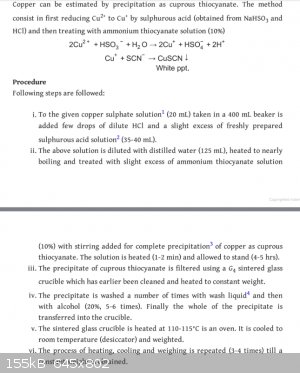
Also here: https://www.google.ca/books/edition/Journal_Chemical_Society...
[Edited on 3-9-2025 by DraconicAcid]
Please remember: "Filtrate" is not a verb.
Write up your lab reports the way your instructor wants them, not the way your ex-instructor wants them.
|
|
|
teodor
International Hazard
Posts: 1169
Registered: 28-6-2019
Location: Netherlands
Member Is Offline
|
|
| Quote: Originally posted by DraconicAcid | | Quote: Originally posted by teodor | Welcome to the board!
This is the nice post, but I can't see the images in the messages.
By SM rules it is always required to provide source of the information you report, you can read the reason for this rule here: https://www.sciencemadness.org/talk/viewthread.php?tid=19143 . When you do, the topic is much easier to discuss for people who didn't perform your
experiment yet.
Also, as far as I know some Cu(II) compounds disproportionate to Cu(I), for example 2CuI2 -> 2 CuI + I2. So, please provide something to read and
understand what you are writing about as a general rule of Cu(I) instability, just to be on the same page.
[Edited on 3-9-2025 by teodor] |
The OP did give a link to a paper on copper(I) complexes, and talked about the decomposition of copper(II) iodide and thiocyanate (not actually a
disproportionation- that would be two Cu(I) -> Cu(II) and Cu(s)). So I'm not sure what you're criticizing the OP for. |
I wish to get more information about copper (I) and (II) relations after reading the post that's why I feel like I am missing some references in the
first message but I am not actually criticizing, I am glad to see actual experiments and original thoughts, that's why I become more demanding.
If the topic is solubility / stability Cu(I)/Cu(II) I also have interest here in regard to phosphates (ortho/poly/meta) of Cu(I) and Cu(II). Also
weird behaviour and structure of Cu(AcO)2. Also - is actually CuSCN is a complex?
So, if you wish to define what we can discuss here I probably can participate. SCN- I don't know much, (SCN)2 is probably unstable but I could be
wrong. I remember there is some reaction with Zn powder when SCN- is converted to cyanide + CS2. So, if this compound is our interest here, why it is
stable in the case of both Cu(I,II) and not stable in the case of Zn presence? Cu(I) is peculiar but SCN- is peculiar also.
[Edited on 3-9-2025 by teodor]
|
|
|
teodor
International Hazard
Posts: 1169
Registered: 28-6-2019
Location: Netherlands
Member Is Offline
|
|
Oh, I see, your main idea is to use kind of complex with chloride to increase CuCl solubility. I didn’t expect Cl anion can form a complex with
itself, usually by complex I recognise inclusion of coordinate agent like water or ammonia, not something similar to anion. This definition of complex
is too broad for me but thanks, there is some new information to think about.
I have checked, there are 3 or 5 know methods of preparation CuSCN from Cu(I) and 10 or 20 from Cu(II) mentioned in Gmelin and your methods looks like
some original discovery. Are you sure the product is reasonably free from chloride? Can you use this method for preparation of other Cu(I) insoluble
compound (I can imagine we need to undestand when “complexation” with Cl- can and cannot work)
[Edited on 4-9-2025 by teodor]
|
|
|
chemodis
Harmless
Posts: 9
Registered: 27-8-2025
Member Is Offline
|
|
| Quote: Originally posted by teodor | Oh, I see, your main idea is to use kind of complex with chloride to increase CuCl solubility. I didn’t expect Cl anion can form a complex with
itself, usually by complex I recognise inclusion of coordinate agent like water or ammonia, not something similar to anion. This definition of complex
is too broad for me but thanks, there is some new information to think about.
I have checked, there are 3 or 5 know methods of preparation CuSCN from Cu(I) and 10 or 20 from Cu(II) mentioned in Gmelin and your methods looks like
some original discovery. Are you sure the product is reasonably free from chloride? Can you use this method for preparation of other Cu(I) insoluble
compound (I can imagine we need to undestand when “complexation” with Cl- can and cannot work)
[Edited on 4-9-2025 by teodor] |
AFAIK chloride doesn't form particularly strong complexes (with copper at least), and exactly this behaviour is needed for the precipitation to work!
If I were to, for example, complex Cu(I) with an excess of CN-, I wouldnt be so sure anymore, if the CuSCN precipitation would work. cyanide forms
much more stable complexes with copper(I) which could possibly keep the Cu(I) complexed and prevent precipitation.
The chloride doesn't form a complex with itself, it's just that both the chloride from the CuCl and NaCl/HCl form the complexes together with Cu(I).
I have no way of testing for chloride yet, but I believe it is rather free of Cl-. I thoroughly washed it and I don't see why there would be any
chloride left. Any form of copper chloride, NaCl, HCl would have been complexed and/or washed out.
I think most insoluble Cu(I) salts should be able to be made this way, except maybe salts of very weak acids. Cu(I) is complexed in a very acidic
environment here, I could imagine anions of weak acids getting protonated. I don't know how to quantify this but the product should be more stable
than CuCl to not get complexed by the excess chloride.
[Edited on 4-9-2025 by chemodis]
|
|
|
chemodis
Harmless
Posts: 9
Registered: 27-8-2025
Member Is Offline
|
|
| Quote: Originally posted by bnull | Some comments. (1) Make a thick paste of Cu2O with a little ethanol or glycerol before making the suspension; both alcohols act as
surfactants. (2) Try a saturated solution of NaCl or NH4Cl in concentrated HCl. (3) I think you can use copper wire in place of sulfite for
shelf life improvement. There's a flask of cuprous chloride complex sitting in my drawer that's still completely clear after more than 10 years thanks
to the bits of copper wire in the bottom.
Welcome to the forum. It is a very nice report.
@DraconicAcid, would it be Hamilton & Simpson's Quantitative Chemical Analysis?
[Edited on 3-9-2025 by bnull] |
Thank you for the kind words, I am definitely going to try that out! The small amounts of alcohol won't affect NaCl solubility significantly, I hope.
For actual 'shelf' life some copper is propably the better choice, but in my case I needed a soluble reducing agent so that it wouldn't end up in the
filter. Being dissolved should also help because it surrounds all the fine CuSCN particles, preventing oxidation.
|
|
|
teodor
International Hazard
Posts: 1169
Registered: 28-6-2019
Location: Netherlands
Member Is Offline
|
|
CuCl is dissolving in ethanol when HCl is passing through it. Quite interesting. So, there is a way to study it in non-aqueous solution. Also probably
it can be used to get higher HCl concentrations in ethanol. There are some publications but in old chinese journals, I unable to get the text. But
they claim there is no complex formation between Cl- and CuCl in ethanol, just increase in solubility. Well, quite old publications.
[Update]
So, if you mix H2O + a bit of HCl and higher alcohol which is not miscible with water (at least forming 2 layers) you can extract some CuCl2 to
alcohol this way. By the difference of color (if any) you can see wether you get the same type of complex or not.
[Edited on 4-9-2025 by teodor]
|
|
|
chemodis
Harmless
Posts: 9
Registered: 27-8-2025
Member Is Offline
|
|
| Quote: Originally posted by teodor | Welcome to the board!
This is the nice post, but I can't see the images in the messages.
By SM rules it is always required to provide source of the information you report, you can read the reason for this rule here: https://www.sciencemadness.org/talk/viewthread.php?tid=19143 . When you do, the topic is much easier to discuss for people who didn't perform your
experiment yet.
Also, as far as I know some Cu(II) compounds disproportionate to Cu(I), for example 2CuI2 -> 2 CuI + I2. So, please provide something to read and
understand what you are writing about as a general rule of Cu(I) instability, just to be on the same page.
[Edited on 3-9-2025 by teodor] |
that's odd, is it still the case? I had to verify my imgur account, maybe the pictures were not showing before verification. also try disabling any
adblockers, I have the suspicion these can block text/image formating.
|
|
|
teodor
International Hazard
Posts: 1169
Registered: 28-6-2019
Location: Netherlands
Member Is Offline
|
|
| Quote: Originally posted by chemodis | | Quote: Originally posted by teodor | Welcome to the board!
This is the nice post, but I can't see the images in the messages.
By SM rules it is always required to provide source of the information you report, you can read the reason for this rule here: https://www.sciencemadness.org/talk/viewthread.php?tid=19143 . When you do, the topic is much easier to discuss for people who didn't perform your
experiment yet.
Also, as far as I know some Cu(II) compounds disproportionate to Cu(I), for example 2CuI2 -> 2 CuI + I2. So, please provide something to read and
understand what you are writing about as a general rule of Cu(I) instability, just to be on the same page.
[Edited on 3-9-2025 by teodor] |
that's odd, is it still the case? I had to verify my imgur account, maybe the pictures were not showing before verification. also try disabling any
adblockers, I have the suspicion these can block text/image formating. |
I can see the pictures from my home computer but I unable to see from my work computer. Probably because you use links to another site and that site
has kind of broken https identification. If you feel like your pictures should be preserved here I would insert them as files, external links very
often become unacessible after, let say, 10 years. But here answering a question asked 15-20 years ago is a normal practice as I can often see 
[Edited on 4-9-2025 by teodor]
|
|
|
chemodis
Harmless
Posts: 9
Registered: 27-8-2025
Member Is Offline
|
|
| Quote: Originally posted by teodor |
I wish to get more information about copper (I) and (II) relations after reading the post that's why I feel like I am missing some references in the
first message but I am not actually criticizing, I am glad to see actual experiments and original thoughts, that's why I become more demanding.
If the topic is solubility / stability Cu(I)/Cu(II) I also have interest here in regard to phosphates (ortho/poly/meta) of Cu(I) and Cu(II). Also
weird behaviour and structure of Cu(AcO)2. Also - is actually CuSCN is a complex?
So, if you wish to define what we can discuss here I probably can participate. SCN- I don't know much, (SCN)2 is probably unstable but I could be
wrong. I remember there is some reaction with Zn powder when SCN- is converted to cyanide + CS2. So, if this compound is our interest here, why it is
stable in the case of both Cu(I,II) and not stable in the case of Zn presence? Cu(I) is peculiar but SCN- is peculiar also.
[Edited on 3-9-2025 by teodor] |
That is definitely intriguing, how would a reaction of SCN- with zinc proceed?
copper phosphates are interesting, though polyphosphates tend to chelate hard cations, so more likely Cu(II), but I will try adding phosphate to a
Cu(I) solution.
[Edited on 4-9-2025 by chemodis]
|
|
|
teodor
International Hazard
Posts: 1169
Registered: 28-6-2019
Location: Netherlands
Member Is Offline
|
|
The chemistry of Cu(II) phosphates is quite reach. Some of them could be used for preparation of phosphates of other metals as starting matherial. But
as for Cu(I) making a first literature check I was able to find only 2 publications - Cu(I) ammino orthophosphate and Cu(I) orthophosphate-thiourea
complex. No poly/meta variations. The same situation for arsenates.
I tried to find the reaction with Zn but reached the time limit. I will look later.
But you can do actually the same heating your CuSCN:
8 CuCNS -> 4 Cu2S + 2CS2 + 3 (CN)2 + N2
(Treadwell, Analytical Chemistry vol.1 )
This is the same as famous pharaoh's serpent rection but with cuprous ion instead of mercuric.
By the way, it is nice way to check for chloride ions.
[Edited on 4-9-2025 by teodor]
|
|
|
DraconicAcid
International Hazard
Posts: 4503
Registered: 1-2-2013
Location: The tiniest college campus ever....
Member Is Offline
Mood: Semi-victorious.
|
|
I seem to recall reading (probably in Cotton & Wilkinson) that copper(I) is the more stable form in acetonitrile, if you want to make cuprous
compounds that aren't water-stable.
Please remember: "Filtrate" is not a verb.
Write up your lab reports the way your instructor wants them, not the way your ex-instructor wants them.
|
|
|
chemodis
Harmless
Posts: 9
Registered: 27-8-2025
Member Is Offline
|
|
| Quote: Originally posted by teodor |
I can see the pictures from my home computer but I unable to see from my work computer. Probably because you use links to another site and that site
has kind of broken https identification. If you feel like your pictures should be preserved here I would insert them as files, external links very
often become unacessible after, let say, 10 years. But here answering a question asked 15-20 years ago is a normal practice as I can often see
[Edited on 4-9-2025 by teodor] |
Good to know. Do you have a clue how to embed images without a 3rd party platform? Since one needs a link to a picture stored online I thought it
was't doable otherwise.
[Edited on 5-9-2025 by chemodis]
|
|
|
chemodis
Harmless
Posts: 9
Registered: 27-8-2025
Member Is Offline
|
|
| Quote: Originally posted by teodor | The chemistry of Cu(II) phosphates is quite reach. Some of them could be used for preparation of phosphates of other metals as starting matherial. But
as for Cu(I) making a first literature check I was able to find only 2 publications - Cu(I) ammino orthophosphate and Cu(I) orthophosphate-thiourea
complex. No poly/meta variations. The same situation for arsenates.
I tried to find the reaction with Zn but reached the time limit. I will look later.
But you can do actually the same heating your CuSCN:
8 CuCNS -> 4 Cu2S + 2CS2 + 3 (CN)2 + N2
(Treadwell, Analytical Chemistry vol.1 )
This is the same as famous pharaoh's serpent rection but with cuprous ion instead of mercuric.
By the way, it is nice way to check for chloride ions.
[Edited on 4-9-2025 by teodor] |
well there is one thing I wouldn't do without a fume hood. But how is that a way to check for chloride ions?
|
|
|
teodor
International Hazard
Posts: 1169
Registered: 28-6-2019
Location: Netherlands
Member Is Offline
|
|
| Quote: Originally posted by chemodis | | Quote: Originally posted by teodor | The chemistry of Cu(II) phosphates is quite reach. Some of them could be used for preparation of phosphates of other metals as starting matherial. But
as for Cu(I) making a first literature check I was able to find only 2 publications - Cu(I) ammino orthophosphate and Cu(I) orthophosphate-thiourea
complex. No poly/meta variations. The same situation for arsenates.
I tried to find the reaction with Zn but reached the time limit. I will look later.
But you can do actually the same heating your CuSCN:
8 CuCNS -> 4 Cu2S + 2CS2 + 3 (CN)2 + N2
(Treadwell, Analytical Chemistry vol.1 )
This is the same as famous pharaoh's serpent rection but with cuprous ion instead of mercuric.
By the way, it is nice way to check for chloride ions.
[Edited on 4-9-2025 by teodor] |
well there is one thing I wouldn't do without a fume hood. But how is that a way to check for chloride ions? |
Just dissolve the decomposition residue in water, filter and test the filtrate for the chloride ions.
For making this analysis you don't need much solid, so test-tube scale decomposition can be done without a fume hood. Calculate the amount of
cyanogen, check its IDL/OSHA and you can get a safe distance between you and the tube. But it is up to you. Fume hood is not so hard to build and as I
said dozen time here, it is not excuse not to have one.
[Update]
This is often the case when very insoluble solid is formed (the best example is BaSO4) it takes ions from the solvent and those ions is not possible
to wash out. And in your case you had a kind of "complex", so the co-precipitation of SCN- and Cl- is quite possible, and if they have isomorphic
crystalls - I think it is unavoidable.
[Update 2]
And grey CuSCN is very likely a polimer, and polimer means a not very regular structure, so it increases the chance of mixed anions.
[Edited on 5-9-2025 by teodor]
|
|
|
DraconicAcid
International Hazard
Posts: 4503
Registered: 1-2-2013
Location: The tiniest college campus ever....
Member Is Offline
Mood: Semi-victorious.
|
|
| Quote: Originally posted by teodor |
And grey CuSCN is very likely a polimer, and polimer means a not very regular structure, so it increases the chance of mixed anions.
|
CuSCN is a coordination polymer, but its crystal structure is known, and it is very much a regular structure.
https://www.sciencedirect.com/science/article/abs/pii/S00201...
Please remember: "Filtrate" is not a verb.
Write up your lab reports the way your instructor wants them, not the way your ex-instructor wants them.
|
|
|
bnull
National Hazard
Posts: 993
Registered: 15-1-2024
Location: East Woods
Member Is Offline
Mood: Fecking annoyed
|
|
It is soluble in diethyl ether, alkali thiocyanates solutions, and ammonia solutions. It is stable in dry air but decomposes in the presence of
moisture. (Handbook of Copper Compounds and Applications)
|
|
|
chemodis
Harmless
Posts: 9
Registered: 27-8-2025
Member Is Offline
|
|
| Quote: Originally posted by teodor | | Quote: Originally posted by chemodis | | Quote: Originally posted by teodor | The chemistry of Cu(II) phosphates is quite reach. Some of them could be used for preparation of phosphates of other metals as starting matherial. But
as for Cu(I) making a first literature check I was able to find only 2 publications - Cu(I) ammino orthophosphate and Cu(I) orthophosphate-thiourea
complex. No poly/meta variations. The same situation for arsenates.
I tried to find the reaction with Zn but reached the time limit. I will look later.
But you can do actually the same heating your CuSCN:
8 CuCNS -> 4 Cu2S + 2CS2 + 3 (CN)2 + N2
(Treadwell, Analytical Chemistry vol.1 )
This is the same as famous pharaoh's serpent rection but with cuprous ion instead of mercuric.
By the way, it is nice way to check for chloride ions.
[Edited on 4-9-2025 by teodor] |
well there is one thing I wouldn't do without a fume hood. But how is that a way to check for chloride ions? |
Just dissolve the decomposition residue in water, filter and test the filtrate for the chloride ions.
For making this analysis you don't need much solid, so test-tube scale decomposition can be done without a fume hood. Calculate the amount of
cyanogen, check its IDL/OSHA and you can get a safe distance between you and the tube. But it is up to you. Fume hood is not so hard to build and as I
said dozen time here, it is not excuse not to have one.
[Update]
This is often the case when very insoluble solid is formed (the best example is BaSO4) it takes ions from the solvent and those ions is not possible
to wash out. And in your case you had a kind of "complex", so the co-precipitation of SCN- and Cl- is quite possible, and if they have isomorphic
crystalls - I think it is unavoidable.
[Update 2]
And grey CuSCN is very likely a polimer, and polimer means a not very regular structure, so it increases the chance of mixed anions.
[Edited on 5-9-2025 by teodor] |
Now I think I get it. The CuSCN might have "encapsuled" some chloride, which is not detectable in this state. So you decompose CuSCN to Cu2S to free
the chloride (although the sulfide is very insoluble too?), then you do a simple chloride test
|
|
|
teodor
International Hazard
Posts: 1169
Registered: 28-6-2019
Location: Netherlands
Member Is Offline
|
|
| Quote: Originally posted by chemodis | | Quote: Originally posted by teodor | | Quote: Originally posted by chemodis | | Quote: Originally posted by teodor | The chemistry of Cu(II) phosphates is quite reach. Some of them could be used for preparation of phosphates of other metals as starting matherial. But
as for Cu(I) making a first literature check I was able to find only 2 publications - Cu(I) ammino orthophosphate and Cu(I) orthophosphate-thiourea
complex. No poly/meta variations. The same situation for arsenates.
I tried to find the reaction with Zn but reached the time limit. I will look later.
But you can do actually the same heating your CuSCN:
8 CuCNS -> 4 Cu2S + 2CS2 + 3 (CN)2 + N2
(Treadwell, Analytical Chemistry vol.1 )
This is the same as famous pharaoh's serpent rection but with cuprous ion instead of mercuric.
By the way, it is nice way to check for chloride ions.
[Edited on 4-9-2025 by teodor] |
well there is one thing I wouldn't do without a fume hood. But how is that a way to check for chloride ions? |
Just dissolve the decomposition residue in water, filter and test the filtrate for the chloride ions.
For making this analysis you don't need much solid, so test-tube scale decomposition can be done without a fume hood. Calculate the amount of
cyanogen, check its IDL/OSHA and you can get a safe distance between you and the tube. But it is up to you. Fume hood is not so hard to build and as I
said dozen time here, it is not excuse not to have one.
[Update]
This is often the case when very insoluble solid is formed (the best example is BaSO4) it takes ions from the solvent and those ions is not possible
to wash out. And in your case you had a kind of "complex", so the co-precipitation of SCN- and Cl- is quite possible, and if they have isomorphic
crystalls - I think it is unavoidable.
[Update 2]
And grey CuSCN is very likely a polimer, and polimer means a not very regular structure, so it increases the chance of mixed anions.
[Edited on 5-9-2025 by teodor] |
Now I think I get it. The CuSCN might have "encapsuled" some chloride, which is not detectable in this state. So you decompose CuSCN to Cu2S to free
the chloride (although the sulfide is very insoluble too?), then you do a simple chloride test |
Correct. You precipitate Cu(I) from the state of coordination and assume those bond to Cl are weak and can't go to the solid state. I am ignoramus in
Cu chemistry, so my first question - why do you know that? CuSCN is precipitated in the state of polymerisation, actually probably it is why so
insoluble. Also CuSCN is a semiconductor (I just checked wikipedia, not much knowledge in that) so it can have ionic "holes" by the definition. You
use a new method probably nobody studied yet. Cl- analysis is not so complex (AgNO3). So, it is quite logical for me to check that.
And yes, all sulfides except for those of alkali metals are very insoluble in neutral solution. Pretty much as oxides or even more.
Well, that study was made for some specific method of preparation.
[Edited on 6-9-2025 by teodor]
[Edited on 6-9-2025 by teodor]
|
|
|
chemodis
Harmless
Posts: 9
Registered: 27-8-2025
Member Is Offline
|
|
| Quote: Originally posted by teodor |
Correct. You precipitate Cu(I) from the state of coordination and assume those bond to Cl are weak and can't go to the solid state. I am ignoramus in
Cu chemistry, so my first question - why do you know that? CuSCN is precipitated in the state of polymerisation, actually probably it is why so
insoluble. Also CuSCN is a semiconductor (I just checked wikipedia, not much knowledge in that) so it can have ionic "holes" by the definition. You
use a new method probably nobody studied yet. Cl- analysis is not so complex (AgNO3). So, it is quite logical for me to check that.
And yes, all sulfides except for those of alkali metals are very insoluble in neutral solution. Pretty much as oxides or even more.
Well, that study was made for some specific method of preparation.
[Edited on 6-9-2025 by teodor]
[Edited on 6-9-2025 by teodor] |
| Quote: | Correct. You precipitate Cu(I) from the state of coordination and assume those bond to Cl are weak and can't go to the solid state. I am ignoramus in
Cu chemistry, so my first question - why do you know that? CuSCN is precipitated in the state of polymerisation, actually probably it is why so
insoluble. Also CuSCN is a semiconductor (I just checked wikipedia, not much knowledge in that) so it can have ionic "holes" by the definition. You
use a new method probably nobody studied yet. Cl- analysis is not so complex (AgNO3). So, it is quite logical for me to check that.
And yes, all sulfides except for those of alkali metals are very insoluble in neutral solution. Pretty much as oxides or even more.
|
They can go to the solid state with the right cation(s) besides Cu+. In the paper I attached in the original post, it was stated that - although Cu+
solubility increases more with KCl/NH4Cl - those performed poorly at complexing Cu+ at higher concentrations because they form a complex salt that
precipitates. Na+ does not form chlorocuprate salts, I don't remember exactly why, but out of the alkali metals, only ions as big as or bigger than K+
form stable chlorocuprate salts.
I have noticed when the complexed Cu+ solution is diluted a lot, CuCl precipitates and the solution loses its brown colour, because chloride
concentration is no longer large enough to form significant amounts of chloride complexes. CuSCN is much less soluble than CuCl, when SCN- is added I
guess the complex equilibrium simply shifts to favour precipitation.
|
|
|
teodor
International Hazard
Posts: 1169
Registered: 28-6-2019
Location: Netherlands
Member Is Offline
|
|
Precipitation in a solvent can happen on methathesis reaction, but here we don't have usual Cu+ and Cl- ions, but some complex ion of Cu surrounded by
Cl and I guess in this state there is no more Cl as a usual anion otherwise I don't see how displacement with SCN- is possible if it is not ionised.
So, I assume if all Cl have equal type of bond to Cu(I) we get a pure compound. But if it is not the case, some Cl from the outer shell will be
replaced faster and the grow of polimer will be not towards all direction with the same rate.
Just imaginary construction without checking publications of chloride complexes, you can ignore it. But I just explain my way of thinking.
[Edited on 8-9-2025 by teodor]
|
|
|
|



![[*]](images/xpblue/default_icon.gif)


