beeology
Harmless

Posts: 4
Registered: 11-9-2008
Member Is Offline
Mood: No Mood
|
|
Piperonal from Ethylvanillin
The aim of this work was to develop a simple yet reproducible method for the synthesis of piperonal using readily available, only slightly toxic or
untoxic chemicals. The synthesis takes place in two steps, each carried out in a home-built autoclave at comparatively low temperatures
(70–85 °C) in a water bath. The setup is simple: just add the reagents to the reactor, seal it, and leave it in the water bath for a calculated
amount of time - minimal workup required.
1. Ethyl vanillin (32.2 g, 200 mmol) was added with stirring to concentrated sulfuric acid (196.6 g, 106 mL, 2000 mmol) in a PVDF-lined
stainless steel autoclave. The autoclave was purged with argon, sealed, and placed in a water bath at 70 °C for 4 hours under continuous stirring.
After completion of the reaction, the mixture was cooled to room temperature and poured onto 420 g of crushed ice in a 1000 mL Erlenmeyer flask.
Stirring was continued until a solid precipitate formed. The supernatant was decanted, and the solids were collected by filtration. The crude product
was obtained as a light gray crystalline mass. It was recrystallized twice from hot water (approximately 80 mL at 60 °C). During the second
recrystallization, the still-hot saturated aqueous solution was subsequently washed with 30 mL of xylene. After separation and cooling, pure
protocatechualdehyde crystallized from the aqueous phase. Yield after drying: 17.4 g, 65%; melting point: 152 °C. This product was used in the
subsequent step without further purification.
2. Protocatechualdehyde (11.7 g, 85 mmol) and tetrabutylammonium bromide (2.7 g) were added to a cooled solution of sodium hydroxide (10.2 g,
225 mmol) in water (85 mL) in the autoclave. After complete dissolution, dichloromethane (85 mL) was added. The autoclave was filled with argon,
sealed, and kept in a water bath at 85 °C for 6 hours with continuous stirring. After this period, the reaction mixture was cooled to room
temperature, and the excess dichloromethane was recovered by simple distillation.
The product was isolated by steam distillation; a total of 500 mL was collected. The distillate was saturated with NaCl and extracted with a total
of 40 mL of dichloromethane. 3.8 g of crude piperonal was obtained after evaporation (30% yield).
Production of protocatechualdehyde, Patent JPH10265428A
High Selectivity in the Oxidation of Mandelic Acid Derivatives and in O-Methylation of Protocatechualdehyde
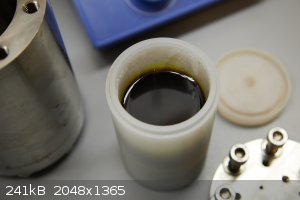 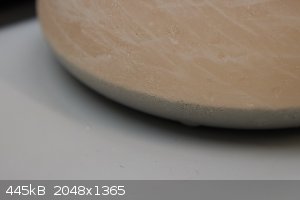
the autoclave and crude protocatechualdehyde settled down in the ice water
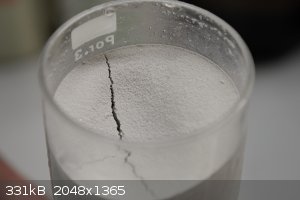 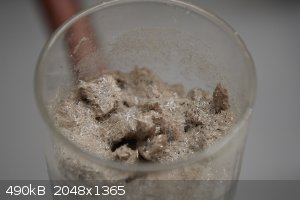
crude and twice recrystallized protocatechualdehyde
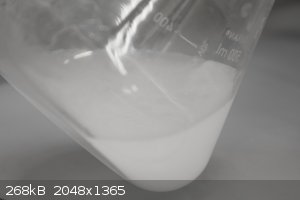 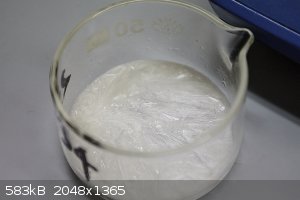
steam distillate and crude piperonal after dichloromethane evaporation
[Edited on 30-9-2025 by beeology]
|
|
|
Niklas
Hazard to Others
Posts: 155
Registered: 1-12-2023
Location: Germany
Member Is Offline
Mood: Polymerized
|
|
Great to actually see this methenylation method being attempted here, unfortunately not the 70% yield stated in the patent (unsurprisingly honestly),
but still a good comparison to have as without a pressure vessel using DMF / potassium carbonate / TBAB I also only managed to achieve 40% at most so
far, although I should soon be doing some more work in that regard in hopes of improving this value (though at this point I really do start
to believe it’s much easier and cheaper to just buy some piperonal acetals as perfume substances and then hydrolize them).
|
|
|
DraconicAcid
International Hazard
Posts: 4521
Registered: 1-2-2013
Location: The tiniest college campus ever....
Member Is Online
Mood: Semi-victorious.
|
|
I've been wanting to try this, but don't have TBAB or a pressure vessel.
Please remember: "Filtrate" is not a verb.
Write up your lab reports the way your instructor wants them, not the way your ex-instructor wants them.
|
|
|
Mateo_swe
National Hazard
Posts: 591
Registered: 24-8-2019
Location: Within EU
Member Is Offline
|
|
Very nice.
Have you tried with plain vanillin as starting material and if so what was the yield of the first stage?
If one reads the papers related to this they state that the pressure developed is quite low.
So one can use a glass pressure bottle or a DIY solution if you dont own a hydrothermal reactor vessel.
If i remember correctly the pressure rised to 2.4 atmospheres.
I hope the last stage can be improved so that more than 30-40% yield can be had.
There are many variations of this procedure that one can try.
Substituting the dichloromethane for the dibromo variant is said to improve yields but unfortunatley its not so easily found as DCM.
Very intresting, plz continue the experimentation.
|
|
|
beeology
Harmless
Posts: 4
Registered: 11-9-2008
Member Is Offline
Mood: No Mood
|
|
Thank you for your feedback.
So far, I have only worked with ethylvanillin, as it is relatively straightforward and requires only sulfuric acid for the conversion. Working with
protocatechualdehyde is a bit delicate and consistently yields variable results, even under seemingly identical reaction conditions. Unfortunately,
commercially available protocatechualdehyde is quite expensive.
According to the paper cited above, an effective yield of 37.5% was achieved in the methylenation step, which is likely the upper limit using this
method. My current approach is to add the reagents in stages to the autoclave, as described in the patent. A pressure gauge would be a useful
addition.
|
|
|
Niklas
Hazard to Others
Posts: 155
Registered: 1-12-2023
Location: Germany
Member Is Offline
Mood: Polymerized
|
|
Demethylating vanillin is significantly more difficult and expensive unfortunately, either methods just genuinely suck like using pyridine
hydrochloride, don’t seem to work at all, or are just pretty expensive if you need a decent amount (I found Pyridine and aluminum chloride to work
pretty well (I got up to about an 80% yield in one run iirc) but at that point at least for me it’s cheaper to just buy protocatechulic aldehyde).
Deethylation on the other hand just needs sulfuric acid, you don’t even need an autoclave as has been reported here before (https://www.sciencemadness.org/whisper/viewthread.php?tid=15... , yields stated there are a bit lower, but I personally found the amount of water
Diachrynic is stating for the recryst to just be somewhat excessive). Also bourbonal isn’t that much more expensive than vanillin as it’s also
widely used as a perfume and flavoring substance.
|
|
|
wittymoniker
Banned
Posts: 12
Registered: 18-11-2025
Location: Parishville NY
Member Is Offline
Mood: Glad
|
|
Great Synthesis bro thanks
-Eski
|
|
|
FableP
Harmless
Posts: 17
Registered: 26-7-2023
Member Is Offline
Mood: No Mood
|
|
Is the TBAB acting as a phase transfer catalyst here or is participating in other ways?
Presumably if its just a PTC, others (more easily sourced or cheaper) could be substituted.
|
|
|
Mateo_swe
National Hazard
Posts: 591
Registered: 24-8-2019
Location: Within EU
Member Is Offline
|
|
I read somewhere that PTCs with longer carbon chains where needed but i dont know if thats true at all.
I looked at cheaper PTCs and the ones with short chains have indeed much lower price.
If those could be used it would be great.
Often TBAB is used for things like this and its often expensive or temporarily out of stock.
|
|
|
bnull
National Hazard
Posts: 999
Registered: 15-1-2024
Location: East Woods
Member Is Offline
Mood: Fecking annoyed
|
|
A fabric softener perhaps? There was a paper about fabric softeners as phase transfer catalysts. I think it is this one: https://pubs.acs.org/doi/10.1021/ed068p69.
|
|
|
Fery
International Hazard
Posts: 1158
Registered: 27-8-2019
Location: Czechoslovakia
Member Is Offline
|
|
beeology - great work, well done! I wonder how much lower would be the yield when performing the reaction without autoclave.
discussion about PTC - TBAB is very cheap, ask chemship1978 for actual pricing. 1 y ago the price was like 30 eur per 500 g.
PTC with shorter chains have some disadvantage but I cannot recall from my memory now, just that the disadvantage disappears right from n-butyl.
|
|
|
FableP
Harmless
Posts: 17
Registered: 26-7-2023
Member Is Offline
Mood: No Mood
|
|
I was thinking that this could be run in PEG400 as I got 1000ml at no cost. Unfortunately I'm not going to have any spare time until mid January to
try it myself.
|
|
|
Mateo_swe
National Hazard
Posts: 591
Registered: 24-8-2019
Location: Within EU
Member Is Offline
|
|
Do you think the sulfuric acid can be substituted for some other acid or replacement chemical?
Allthough i have some sulfuric acid it has been increasingly more difficult to get it where i live and if something else can be used i rather try that
and save my sulfuric acid as i dont have very much of it.
|
|
|
Fery
International Hazard
Posts: 1158
Registered: 27-8-2019
Location: Czechoslovakia
Member Is Offline
|
|
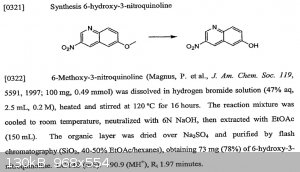
HBr cleaves ether bond (but not HCl).
https://commonorganicchemistry.com/Rxn_Pages/O_Demethylation...
|
|
|
Mateo_swe
National Hazard
Posts: 591
Registered: 24-8-2019
Location: Within EU
Member Is Offline
|
|
Interesting, maybe i can do some experiments during Christmas/new year when i have some time.
I do have some 48% HBr.
I wonder if this would work on ethyl vanillin.
[Edited on 2025-11-28 by Mateo_swe]
|
|
|
0_Q
Harmless
Posts: 7
Registered: 15-12-2018
Member Is Offline
|
|
hey i got good success methylenating 5-hydroxyeugenol with DBM and TBAI
the key was to use 30% NaOH solution and drip in a solution of 5-oh eugenol in an excess of DBM. while refluxing everything.
my yield was 66% of myristicine.
i fear such approach on protocatchualdehyde would result in an cannizarro reaction no?
maybe thats why u got the low yield. i am wondering if we could use another base.
KF maybe but no.. xD
K2CO3 ll result also in cannizarro
|
|
|
Mateo_swe
National Hazard
Posts: 591
Registered: 24-8-2019
Location: Within EU
Member Is Offline
|
|
Interesting, did you buy the DBM or made it yourself?
|
|
|
zed
International Hazard
Posts: 2328
Registered: 6-9-2008
Location: Great State of Jefferson, City of Portland
Member Is Offline
Mood: Semi-repentant Sith Lord
|
|
Hnuh?
How did you produce 5-Hydroxyeugenol?
|
|
|
Mateo_swe
National Hazard
Posts: 591
Registered: 24-8-2019
Location: Within EU
Member Is Offline
|
|
Yes i agree, if he didn´t buy the 5-Hydroxyeugenol it it would be interesting to know how it was prepared.
He probably bought it online though if i were to guess.
The DBM also, it´s a better methylating agent than DCM but its not easily commonly available so if it was prepared it would be interesting info.
|
|
|
chempyre235
Hazard to Others
Posts: 224
Registered: 21-10-2024
Location: Between Nb and Tc
Member Is Offline
Mood: Quite distracted
|
|
Quote: Originally posted by Mateo_swe  | Yes i agree, if he didn´t buy the 5-Hydroxyeugenol it it would be interesting to know how it was prepared.
He probably bought it online though if i were to guess.
The DBM also, it´s a better methylating agent than DCM but its not easily commonly available so if it was prepared it would be interesting info.
|
Agreed, a synth would be interesting. I've seen that DBM can be made with DCM, aluminum, and bromine, or from bromoform with sodium hydroxide and
sodium arsenite, but I don't have any specifics. I wonder too, if the arsenite could be substituted with another reductant, such as calcium sulfite or
copper(I) chloride.
[Edit]: What's more, in addition to making methylenedioxy compounds, DBM can be used in cyclopropanation reactions. An amateur-friendly way to make
cyclopropanes would be very interesting indeed.
[Edited on 2/13/2026 by chempyre235]
"However beautiful the strategy, you should occasionally look at the results." -Winston Churchill
"I weep at the sight of flaming acetic anhydride." -@Madscientist
"...the elements shall melt with fervent heat..." -2 Peter 3:10
|
|
|
0_Q
Harmless
Posts: 7
Registered: 15-12-2018
Member Is Offline
|
|
DBM was bought.
the hydroxyeugenol was made by duff reaction from eugenol 
i can write a writeup in an new topic for u guys.
so my research wont go to waste.. for some years, eventually everything ll go to waste sooner or later
|
|
|
0_Q
Harmless
Posts: 7
Registered: 15-12-2018
Member Is Offline
|
|
https://www.sciencemadness.org/whisper/viewthread.php?tid=16...
here you go
|
|
|


![[*]](images/xpblue/default_icon.gif)


