Ralf
Harmless

Posts: 10
Registered: 21-2-2025
Member Is Offline
|
|
Make liquid chlorine with a simple freezing mixture
With the help of a cooling mixture of snow and table salt, some gases can be liquefied, such as sulfur dioxide. For other gases, such as chlorine,
however, the temperature that can be achieved with this mixture is not low enough, and dry ice is preferred instead. A lesser-known alternative is a
mixture of snow and calcium chloride hexahydrate, which can be easily produced from dehumidifier granules. This mixture can achieve temperatures just
below -50 °C, which is more than sufficient for liquefying chlorine.
Production of calcium chloride hexahydrate:
In a large beaker, 303 g (16.83 mol) of water is added to 620 g (4.22 mol) of calcium chloride dihydrate (dehumidifier granules), and the salt is
dissolved while stirring and heating.
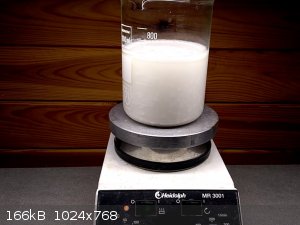
Place the cloudy solution in an ice bath and allow it to cool, stirring occasionally with a glass rod, until a thick paste of calcium chloride
hexahydrate forms.
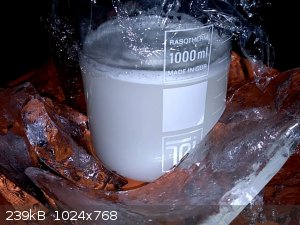
The mass is placed in a Buchner funnel in several portions and sucked off.
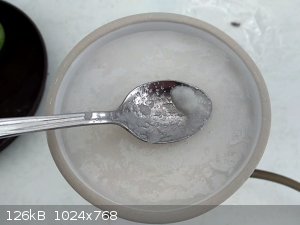
In my case, the filtrate had a volume of approx. 100 ml and the crystals weighed approx. 750 g. They are stored in an airtight container because they
are hygroscopic.
Production and liquefaction of chlorine:
Place 17.5 g of coarsely powdered trichloroisocyanuric acid (TCCA) in a suction flask (250 ml), add a stirring bar, and place the flask on a magnetic
stirrer. Connect a dropping funnel with 54 ml of 15% hydrochloric acid. Connect the gas generator to a glass tube (I used a test tube without a
bottom) filled with granules of anhydrous calcium chloride using a lab tubing. Connect another lab tubing to the other end of the prepared drying tube
and insert a glass capillary into the end of the lab tubing.
The cooling mixture is made from dry snow (below 0 degrees Celsius) and ice-cold calcium chloride hexahydrate in a ratio of 1:1.43. To do this, both
components are weighed beforehand and placed in two containers. Snow and salt are then added alternately in large portions with a spoon through a
powder funnel into the insulated container (Dewar vessel)
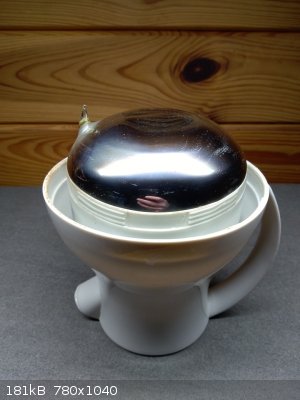 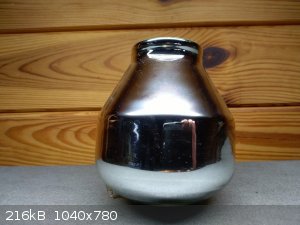
from a small thermos flask (see photos above), stirring with a wooden stick. The container should be filled to 1 to 2 cm below the rim. For the
approximately 350 ml thermos flask, I needed an estimated 250 g of calcium chloride hexahydrate and 175 g of snow. Use a thermometer to check whether
the temperature is low enough (at least -35 °C, preferably below -40 °C). If not, stir the mixture a little longer.
Insert the gas inlet tube with the glass capillary into the ampoules, which are made of thick-walled glass tubes, fused at one end and narrowed at the
other, and start the chlorine development in the gas generator by slowly adding hydrochloric acid to the TCCA (1 drop every 3 seconds). Break up the
foam that forms in the gas generator by stirring magnetically and accelerate the gas generation by heating gently.
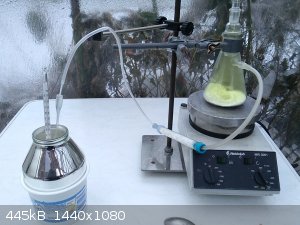
After adding the first drops of hydrochloric acid, place the ampoules in the cold bath so that the chlorine gradually condenses, which takes 5 to 30
minutes depending on the quantity.
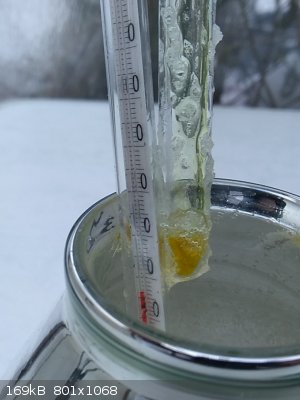
The filled ampoules are transferred to a small beaker containing a fresh cold mixture and sealed with a strong burner. I made the ampoules from
borosilicate glass, which is tough, so in this case you have to fix them in place at the bottom (using a test tube holder) while sealing them. Once
the seal has cooled down, remove them from the cold bath and allow them to warm up slowly to 0 °C. There should be no smell of chlorine, otherwise
the ampoules are leaking. To test the pressure resistance, I heated my ampoules for 10 minutes to 65-70 °C (thick ampoule) or 70-80 °C (thin
ampoule). Once tested in this way, they can be stored at room temperature without hesitation. The pressure inside is then approximately 7 bar.
After using about 3/4 of the hydrochloric acid, I obtained approximately 1.1 and 2.6 ml of liquid chlorine in two ampoules, which corresponds to a
total weight of 5.5 g at a density of 1.5 g/cm³. This is a yield of 43%.
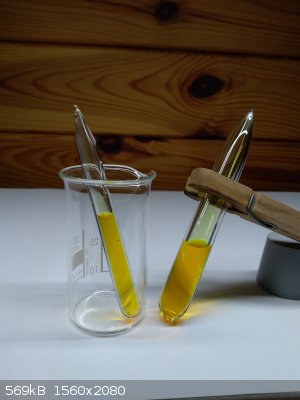
Because I was unable to melt the large ampoule for a long time, approximately 2.5 to 3 ml of the already liquefied chlorine evaporated. Under normal
circumstances, a yield of approximately 75% would therefore be realistic.
Note: An alternative to a Dewar vessel would be a Styrofoam box, for example. However, a standard beaker would probably heat up too quickly
from the outside. The cooling mixture maintained a temperature between -45 and -40 °C for over an hour, but did not reach the literature value of
below -50 °C because the conditions were not ideal. After the experiment, I noticed that there were still large salt crystals at the bottom of the
insulated container. It would be best to obtain more soluble, i.e., smaller crystals when producing calcium chloride hexahydrate by using a little
more water and stirring constantly. In addition, the salt should ideally be dried over sulfuric acid.
Source: Hermann Hammerl (1878) Über die Kältemischung aus Chlorcalcium und Schnee. Sitzungsberichte der Kaiserlichen Wiener Akademie der
Wissenschaften, 78, 59-79.
Explanation:
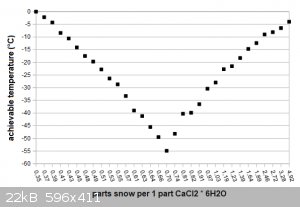
When calcium chloride hexahydrate is mixed with ice, an endothermic reaction takes place. The driving force behind the reaction is the increase in
entropy caused by the calcium and chloride ions dissolving and the melting snow. In contrast to the refrigerant mixture of table salt and ice, this
method achieves temperatures as low as -55 °C (instead of -21 °C) because calcium chloride lowers the freezing point of water more than sodium
chloride.
Question:
Do you agree with this explanation? If yes, why does the calcium chloride lead to a stronger freezing-point depression than NaCl? I
would like to completely and deeply understand, why calcium chloride (hexahydrate) lowers the temperature so much more than NaCl.
|
|
|
DraconicAcid
International Hazard
Posts: 4509
Registered: 1-2-2013
Location: The tiniest college campus ever....
Member Is Offline
Mood: Semi-victorious.
|
|
I think the calcium chloride lowers the freezing point more simply because it's more soluble at low temperatures than NaCl.
I'm impressed that you were able to seal up the chlorine. Nice work!
Please remember: "Filtrate" is not a verb.
Write up your lab reports the way your instructor wants them, not the way your ex-instructor wants them.
|
|
|
Ralf
Harmless
Posts: 10
Registered: 21-2-2025
Member Is Offline
|
|
Thanks. Since the temperature never rose to more than -40 °C, sealing the ampoules wasn't that difficult. The loss of chlorine from the thick ampoule
was just a stupid mistake.
The solubility indeed seems to correlate somewhat with the melting point depression. But there are salts with lower solubility than NaCl which lower
the melting point of water more (e.g. magnesium chloride, see below).
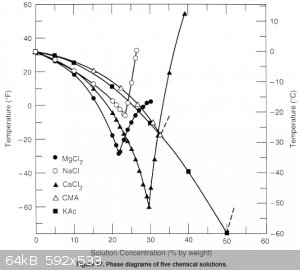
and ammonium nitrate has a higher solubility than calcium chloride, but you can't get such low temperature using it.
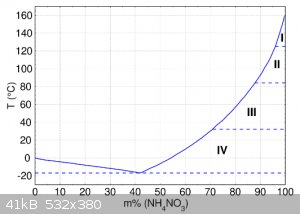
So this property doesn't seem to explain the effect of CaCl2 vs. NaCl.
|
|
|
Radiums Lab
Hazard to Others
Posts: 299
Registered: 18-3-2025
Location: India
Member Is Offline
Mood: Experiencing the elegance of science.
|
|
Nice work, keep it up.
I didn't knew about this method and I think the Cl2 is liquid because of the pressure produced by the newly formed chlorine and the low temperature.
This might give slightly lesser yields than the dry ice method but it's good for me because I can't get any LN2, Dry Ice near my place.
I am going to try this in the near future.
Thanks for posting
[Edited on 3-2-2026 by Radiums Lab]
Water is dangerous if you don't know how to handle it, elemental fluorine (F₂) on the other hand is pretty tame if you know what you are doing.
|
|
|
DraconicAcid
International Hazard
Posts: 4509
Registered: 1-2-2013
Location: The tiniest college campus ever....
Member Is Offline
Mood: Semi-victorious.
|
|
If you're looking for your next project, N2O3 has a gorgeous colour, and should ampule similarly.
Please remember: "Filtrate" is not a verb.
Write up your lab reports the way your instructor wants them, not the way your ex-instructor wants them.
|
|
|
SplendidAcylation
Hazard to Others
Posts: 213
Registered: 28-10-2018
Location: Starving in some deep mystery
Member Is Offline
Mood: No one I think is in my tree.
|
|
Fantastic work! I would love a sample of liquid chlorine to accompany my ampoules stannic chloride and bromine.....
Might give it a try one of these days, thanks for the inspiration!
|
|
|
Fery
International Hazard
Posts: 1130
Registered: 27-8-2019
Location: Czechoslovakia
Member Is Offline
|
|
Great !!! Very pure product, well ampouled, nice amounts.
Good that you dried Cl2 gas as it contained a lot of H2O vapor when generated using 15% HCl. Praise that you did the experiment outside when few ml of
liquid Cl2 evaporated - I did it inside without fumehood and it was something terrible, also few ml evaporated as I'm not much skilled in glassworking
(even no good torch).
|
|
|
Fery
International Hazard
Posts: 1130
Registered: 27-8-2019
Location: Czechoslovakia
Member Is Offline
|
|
Btw IIRC also cooling bath ice + conc. HCl is good but I'm unable to recall its properties from my head just now.
|
|
|
Ralf
Harmless
Posts: 10
Registered: 21-2-2025
Member Is Offline
|
|
Yes, HCl is good. I also tried it. See here: https://www.sciencemadness.org/whisper/viewthread.php?tid=16...
BTW: I made a mistake. I only got 34 % yield with the chlorine (not 43 %), though I can't edit my first post any longer.
I also liquefied some ammonia and propane with CaCl2*6H2O/snow mixture as you can see in the freezing mixture thread.
|
|
|
Texium
Administrator
Posts: 4748
Registered: 11-1-2014
Location: Salt Lake City
Member Is Offline
Mood: Seeking gainful employment
|
|
Freezing point depression is a colligative property. It is dependent on the total concentration of solute particles in solution, regardless
of their identity. CaCl2 dissociates into three ions when it dissolves, so it is 1.5 times as potent per mole of salt as NaCl or
NH4NO3.
If you made solutions of equal concentration of those three salts, the CaCl2 would have the lowest freezing point, and the NaCl and
NH4NO3 would have equal freezing points. So solubility is important of course, since higher concentration = lower freezing
point, but high solubility combined with more ions in solution is especially good.
Endothermic dissolution is important so that your solution gets colder as the salt dissolves, but it’s independent from what the magnitude of the
freezing point depression is.
I’d be curious to see how cold you can get a mixture with AlCl3•6H2O since it splits into 4 ions, though it doesn’t have
quite as high solubility.
Also, very nice post overall! Thank you for sharing your write-up.
|
|
|
Ralf
Harmless
Posts: 10
Registered: 21-2-2025
Member Is Offline
|
|
Thanks for the explanation! So it only depends on the concentration of ions in solution, right? I showed some graphs above which made me think that
the melting point depression depends on the identity of the ions. But if the concentration of ions (instead of mass) is used, the following graphs
should result, right?
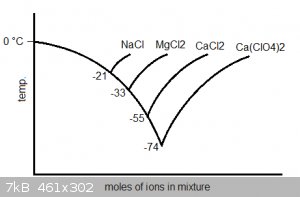
(I'm not sure any longer if the -55 °C for CaCl2 are true. Newest sources claim 49.95 °C eutectic)
There are some differences between the graphs in reality, even when the molar mass is taken into account.
The eutectic temperature of AlCl3 + H2O is said to be -52 °C.
Combining 2 or 3 salts (all consisting of different ions) could even generate lower temps, I think.
|
|
|
chempyre235
Hazard to Others
Posts: 219
Registered: 21-10-2024
Location: Between Nb and Tc
Member Is Offline
Mood: Quite distracted
|
|
Quote: Originally posted by Texium  | Freezing point depression is a colligative property. It is dependent on the total concentration of solute particles in solution, regardless
of their identity. CaCl2 dissociates into three ions when it dissolves, so it is 1.5 times as potent per mole of salt as NaCl or
NH4NO3.
If you made solutions of equal concentration of those three salts, the CaCl2 would have the lowest freezing point, and the NaCl and
NH4NO3 would have equal freezing points. So solubility is important of course, since higher concentration = lower freezing
point, but high solubility combined with more ions in solution is especially good.
Endothermic dissolution is important so that your solution gets colder as the salt dissolves, but it’s independent from what the magnitude of the
freezing point depression is.
I’d be curious to see how cold you can get a mixture with AlCl3•6H2O since it splits into 4 ions, though it doesn’t have
quite as high solubility.
Also, very nice post overall! Thank you for sharing your write-up. |
The perchlorate salt of aluminum seems to have a much higher solubility (~200,000g/L) than the chloride (486g/L) at room temperature. I'm not sure
about in Europe (I presume OP is European from context clues), but perchlorates are readily available in the US from pyrotechnics suppliers. A
metathesis of calcium perchlorate and alum should get the salt, I'd think.
@Ralf, very good work! I've been intrigued by your work not only in the cooling solutions, but also in the applications demonstrated. Nice job on the
chlorine and ammonia experiments, too!
"However beautiful the strategy, you should occasionally look at the results." -Winston Churchill
"I weep at the sight of flaming acetic anhydride." -@Madscientist
"...the elements shall melt with fervent heat..." -2 Peter 3:10
|
|
|



![[*]](images/xpblue/default_icon.gif)


