Fery
International Hazard

Posts: 1127
Registered: 27-8-2019
Location: Czechoslovakia
Member Is Offline
|
|
2,4,6-trimethylpyrylium perchlorate
The experiment was performed according orgsyn method at 10-times smaller scale with 2-times worse yield in winter with outside temperature -8 C.
Amounts of reactants were weighed on a scale, their volume was not measured.
https://orgsyn.org/demo.aspx?prep=CV5P1106
https://orgsyn.org/Content/pdfs/procedures/CV5P1106.pdf
Attachment: CV5P1106.pdf (342kB)
This file has been downloaded 31 times
Diachrinic recently synthesized 2,4,6-triphenylpyrylium bisulfate: https://www.sciencemadness.org/whisper/viewthread.php?tid=16...
preparation before experiment: t-butanol was dried using anhydrous K2CO3 at temperature above 25 C for 1 week and distilled
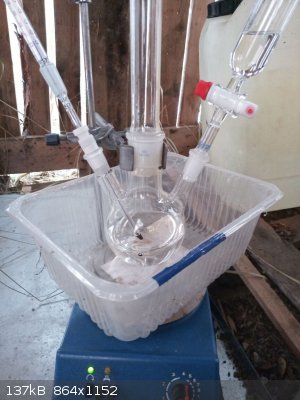
apparatus: 3 neck 250 ml RBF equipped with air condenser, thermometer, dropping funnel, magnetic stirring
experiment:
Into RBF was added 14,8 g t-butanol + 102,0 g acetic anhydride at room temperature while mg. stirring, transferred outside and let to cool down below
0 C.
25,0 g 70% HClO4 was dropped into the reaction very slowly from the beginning. Snow-water bath was applied to keep T below 50 C until crystals of
product appeared. Then the addition of HClO4 was continued faster than at the beginning, when completed, the T was 70 C (too much cooling or too slow
addition or just 10-times less scale?). Heating was applied to reach T 105 C which was kept for 15 minutes, then heating stopped and the reaction
slowly cooled down to 10 C. Magnetic stirring stopped and flask let to stay undisturbed for 2 weeks at 10 C (unnecessary long, I did not have time to
complete the experiment earlier).
Product was vacuum filtered on sintered glass, washed 2x with 20 ml of 1:1 mixture acetic acid : diethylether (orgsyn washed only once, but I wanted
my product as pure as possible), 2x with 20 ml of diethylether. Air dried. Yield 8,9 g.
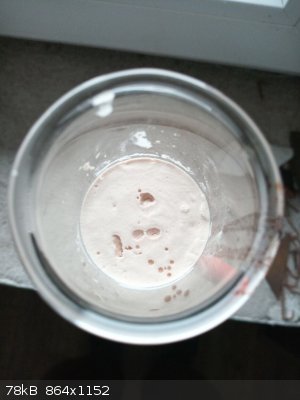
t-butanol + acetic anhydride before HClO4 addition
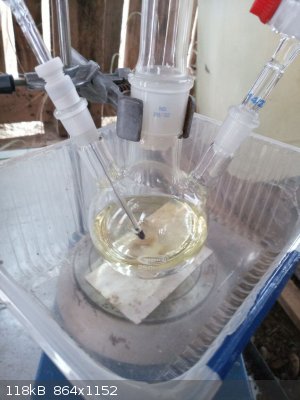
after first drop of HClO4
after few drops of HClO4
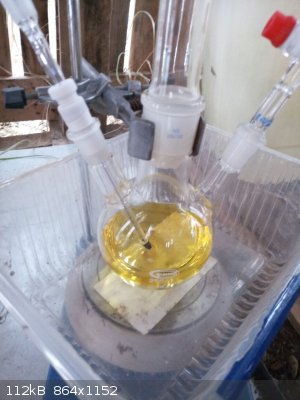
T rose quickly at the beginning
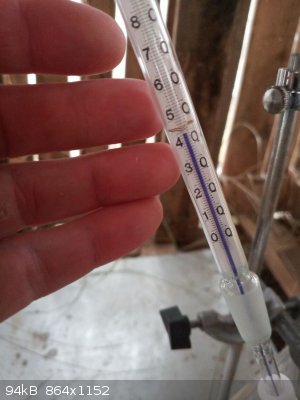
continuing addition of HClO4
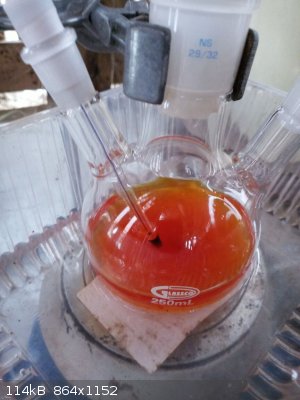 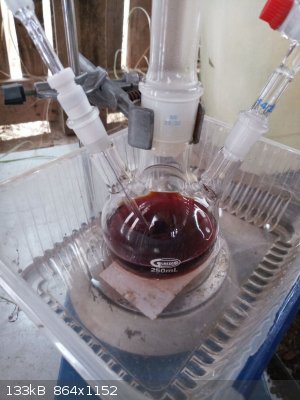
snow + water cooling applied to keep T below 50 C until crystals of the product appeared
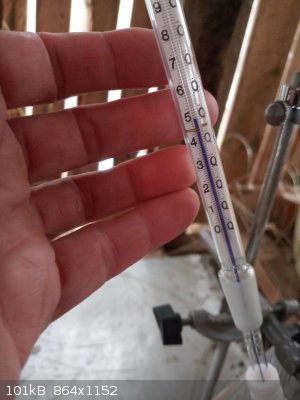 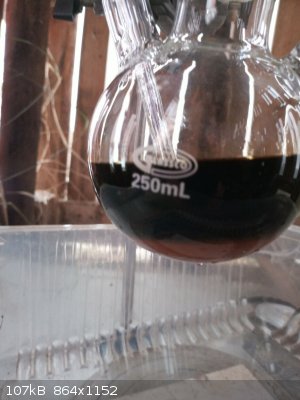
when the addition was done the T was only 70 C so cooling bath removed, but the T did not rise further, then heating mantle used to increase the T to
105 C... I do not know whether heating was necessary and whether the 70 C was not already enough
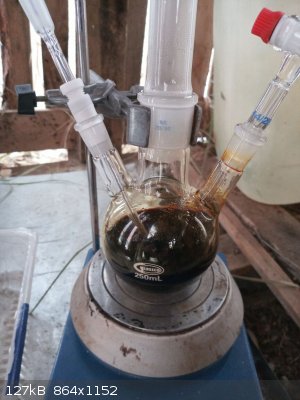 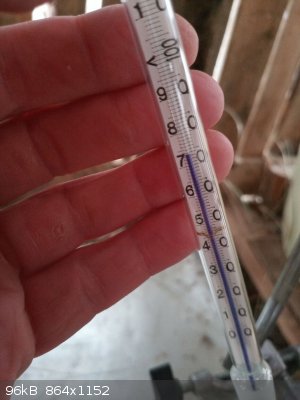 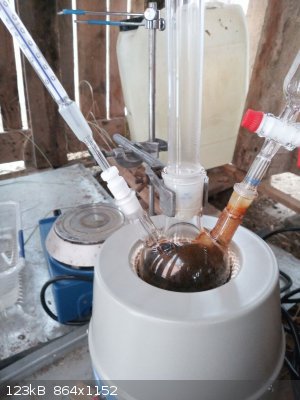
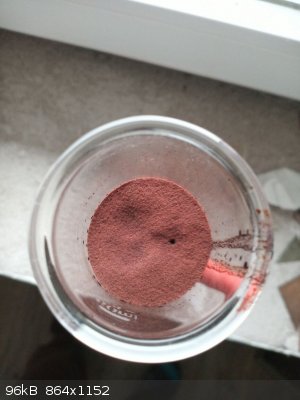
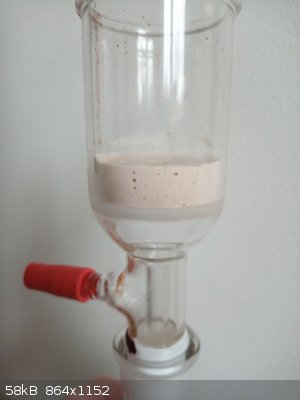
vacuum filtration of the product and the product after washing
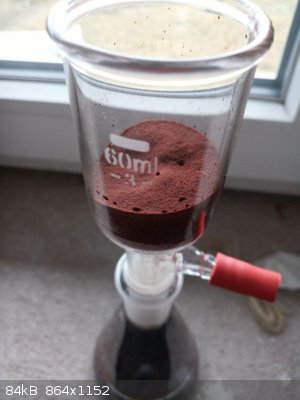 
[Edited on 8-2-2026 by Fery]
|
|
|
Boffis
International Hazard
Posts: 1927
Registered: 1-5-2011
Member Is Offline
Mood: No Mood
|
|
Nice work again Fery! A quality write-up with great photos too. This is an interesting compound and I may have to have ago myself. Once formed do you
think it would be possible to displace the perchlorate ions with say chloride ions by mixing an aqueous solution with a molar equivalence of potassium
chloride? The idea of scraping the compound off sintered glass sounds risky!
|
|
|
Boffis
International Hazard
Posts: 1927
Registered: 1-5-2011
Member Is Offline
Mood: No Mood
|
|
Nice work again Fery! A quality write-up with great photos too. This is an interesting compound and I may have to have ago myself. Once formed do you
think it would be possible to displace the perchlorate ions with say chloride ions by mixing an aqueous solution with a molar equivalence of potassium
chloride? The idea of scraping the compound off sintered glass sounds risky!
|
|
|
Boffis
International Hazard
Posts: 1927
Registered: 1-5-2011
Member Is Offline
Mood: No Mood
|
|
Nice work again Fery! A quality write-up with great photos too. This is an interesting compound and I may have to have ago myself. Once formed do you
think it would be possible to displace the perchlorate ions with say chloride ions by mixing an aqueous solution with a molar equivalence of potassium
chloride? The idea of scraping the compound off sintered glass sounds risky!
|
|
|
Boffis
International Hazard
Posts: 1927
Registered: 1-5-2011
Member Is Offline
Mood: No Mood
|
|
Nice work again Fery! A quality write-up with great photos too. This is an interesting compound and I may have to have ago myself. Once formed do you
think it would be possible to displace the perchlorate ions with say chloride ions by mixing an aqueous solution with a molar equivalence of potassium
chloride? The idea of scraping the compound off sintered glass sounds risky!
|
|
|
Boffis
International Hazard
Posts: 1927
Registered: 1-5-2011
Member Is Offline
Mood: No Mood
|
|
Nice work again Fery! A quality write-up with great photos too. This is an interesting compound and I may have to have ago myself. Once formed do you
think it would be possible to displace the perchlorate ions with say chloride ions by mixing an aqueous solution with a molar equivalence of potassium
chloride? The idea of scraping the compound off sintered glass sounds risky!
|
|
|
Boffis
International Hazard
Posts: 1927
Registered: 1-5-2011
Member Is Offline
Mood: No Mood
|
|
Nice work again Fery! A quality write-up with great photos too. This is an interesting compound and I may have to have ago myself. Once formed do you
think it would be possible to displace the perchlorate ions with say chloride ions by mixing an aqueous solution with a molar equivalence of potassium
chloride? The idea of scraping the compound off sintered glass sounds risky!
|
|
|
DraconicAcid
International Hazard
Posts: 4506
Registered: 1-2-2013
Location: The tiniest college campus ever....
Member Is Offline
Mood: Semi-victorious.
|
|
I wonder if one could use HBF4 instead of perchloric acid.
Impressive work!
Please remember: "Filtrate" is not a verb.
Write up your lab reports the way your instructor wants them, not the way your ex-instructor wants them.
|
|
|
Boffis
International Hazard
Posts: 1927
Registered: 1-5-2011
Member Is Offline
Mood: No Mood
|
|
Can one of the moderator delete some of the duplicates of my post please! Not sure what went wrong but I was having problems with access to the site
today.
|
|
|
Fery
International Hazard
Posts: 1127
Registered: 27-8-2019
Location: Czechoslovakia
Member Is Offline
|
|
Hi Boffis, I scrapped the product while it was still wet, I used plastic spoon. I had a big protective shield on my face just to be sure. Using
Buchner funnel with filtration paper is safer.
The displacement reaction with KCl may work, just the solubility of 2,4,6-trimethylpyrylium perchlorate in cold water is very likely poor, in boiling
water much better (7-fold amount of hot water should be used for recrystallization). Maybe chloride could be prepared by introducing HCl gas into the
reaction instead of HClO4, in that case the amount of acetic anhydride could be maybe reduced as it reacts with water in 70% HClO4, but I do not know
whether solubility of chloride is not too much high in acetic acid and whether it crystallizes.
I encountered the problems with sciencemadness forum repeatedly during last 1 month, https://sciencemadness.org/ always appears quickly, but clicking the link "forum" displays nothing, browser is just waiting for something.
DraconicAcid - yes, you can. Diachrinic posted a link to orgsyn in his post with syntesis using HBF4. This is much safer compound than perchlorate. I
was happy that I finally had some usage for HClO4 which I've bought long time ago when it was still available without restrictions and cheap.
|
|
|
Fery
International Hazard
Posts: 1127
Registered: 27-8-2019
Location: Czechoslovakia
Member Is Offline
|
|
You can also save some of the acetic anhydride when using mesityl oxide instead of t-butanol, in the link to orgsyn there are both methods of the
synthesis.
Kitchen plastic funnel with a plastic mesh (analogy of Hirsch funnel) with filter paper could be much safer than sintered glass or porcelain Buchner.
Shrapnels of glass are not visible in tissues by surgeon eyes thus impossible to remove from body on an accident, they are also almost invisible on
X-ray scans.
|
|
|



![[*]](images/xpblue/default_icon.gif)


