| Pages:
1
..
15
16
17 |
qwerty
Harmless

Posts: 11
Registered: 10-12-2024
Member Is Offline
|
|
I reviewed the DetVel data. Its a table with time data and optical channel rise data. They show 8 channels but they use 4 as the STL file also has 4
holes for fiber optics spaced 15mm apart. I've tried to convert them to a useable detvelocity by am missing a factor of 10000000 (0,1 microsecond)
somewhere, i'm guessing. Took the output on every channel of around 1000 and noted the timestamp there.
from this I think they got
5614m/s over the 1st 15mm of explosive material
6107m/s over the 2nd 15mm
7411m/s over the last 15mm
For an average of 6292m/s Vdet.
Quote: Originally posted by Axt  |
Supporting info presents their preparation, there's also raw VOD data but that's too hard to decipher. I'm sure someone will buy it heh.
The synthesis procedure was as follows:
For each batch, 1.4g (10mmol) of Aminoguanidine bicarbonate was dissolved into 25ml of distilled water into a beaker with continuous stirring, at room
temperature. 2g (12mmol) of 60% perchloric acid was added to the solution, and stirring kept until the CO2 formation stopped and the solution was free
of visible gas bubbles. Then 1.6g (4.4mmol) of Nickel perchlorate hexahydrate were added.
At this point, the patent mentions that crystals start to form “in a few hours”. However, for us this was not the case, and adjusting the pH of
the solution was the only thing that seemed to make the crystals form. The pH adjustment was made by adding dilute NaOH solution dropwise, and
checking the pH at each level. The adding of NaOH changes the solution’s color from green to blue, and, when a pH of 7 is achieved, red crystals
start to immediately precipitate. The formation of the crystals raises the pH of the solution again, which self-limits the quantity of final product
obtained, if no subsequent pH adjusting is done. The yields were always greater than 70% (1.2g of NAP). To get the maximum yield without overshooting
the pH and start favorizing the formation of Ni(OH)2, multiple filtrations of the crystals were made and then readjustments of the pH for the filtered
solution. Using this method yields as high as 90% were obtained.
|
[Edited on 23-10-2025 by qwerty]

[Edited on 23-10-2025 by qwerty]
[Edited on 23-10-2025 by qwerty]
|
|
|
qwerty
Harmless
Posts: 11
Registered: 10-12-2024
Member Is Offline
|
|
Took another look at the measurements an instead of sensor value of around 1000 I looked for the highest value that is the same over all sensors.
4095 seems to be the number that you find on all channels.
By doing this I get
5850
5878
5656
With an average of 5793
Seems to be the more accurate aproach
Some interesting info on the optimex device used
https://yadda.icm.edu.pl/baztech/element/bwmeta1.element.baz...
https://www.ozm.cz/int/AppNotes/OPTIMEX_AppNote.pdf
[Edited on 23-10-2025 by qwerty]
|
|
|
freeflyfreak
Harmless
Posts: 11
Registered: 26-10-2015
Member Is Offline
Mood: calm and collected
|
|
Long time lurker with something I thought worth contributing.
Having done the iNAP synth, I became curious about the yield and remaining Ni carbonate, so I filtered and evaporated the Isopropanol solution and
found a significant amount of what I believe to be Aminoguanidine Perchlorate remaining.
I recently worked up a few small batches of NAP, trying out different salts and solvents. Just dropping a couple successes here in case anyone is
inclined to know more or try themselves. Both yielded dark red, nearly pure small crystals, far richer in color and apparent purity.
First
1g AGB, .88 AP and .68 Ni Acetate. in 10 ml 91% Isopropyl.
50lm low form beaker the solvent was brought to rolling boil (70C)
Mixture of dry ingredients were added at once
Color quickly changes to lime, dark green and black with red tint
Red crystals began to appear on the surface, followed by small crystals in solution at the 3 minute mark
Removed from heat and allowed to cool for 5 minutes to 15C
Crash out was complete by 10 minutes
Dish was placed on 30C hotplate to evaporate to dryness
1.45g dark red crystals with a small amount(~2%) of opaque aminoguanidine perchlorate as impurity.
You can extract the remaining solvent if you want purity.
second success was the same as above but using 10ml methanol(and Ni Acetate)
Outcome was similar to the above after evaporation( no solvent was removed)
Methanol dissolves the Ni Acetate and the result is a very speedy process, with the black/red tint showing up in around a minute.
Both of the above can be filtered to remove the AGP and it can be recovered by evaporation on it's own for feedstock.
Cheers.
|
|
|
ManyInterests
International Hazard
Posts: 1037
Registered: 19-5-2019
Member Is Offline
|
|
I am also having one issue with my iNAP. I made several batches and most of them have been very light pink and very effective as a primary (I tested
them out in several blasting caps and it is by far the absolutely the best primary I have used... in both safety and initiating power). But I did make
a few batches that were not quite as light pink and were dark colored and/or had some unreacted nickel carbonate. I am not sure why it happened, but I
kept those batches separate and I decided to see what would happen if I dissolved that batch again in more 91% isopropyl and boiled the stuff down
again (with strong stirring of course), it got even darker, and I am not sure why.
I'll wait for all the IPA to dry up before reporting. They popped just fine from flame before. I wonder if anything will change.
|
|
|
sulfuric acid is the king
Hazard to Self
Posts: 96
Registered: 11-1-2017
Member Is Offline
|
|
Can NAP be dextrinated and what would the process look like?
|
|
|
qwerty
Harmless
Posts: 11
Registered: 10-12-2024
Member Is Offline
|
|
On page 15 of this thread KFeNAT used PVA to controll chrystal growth.
I remember reading somewhere that dextrin was not effective
|
|
|
Sir_Gawain
National Hazard
Posts: 527
Registered: 12-10-2022
Location: southeast
Member Is Offline
|
|
Axt, I tried that method you posted with some changes and it works phenomenally. Procedure was as follows:
1.4g of Aminoguanidine bicarb was added to about 25 mL of warm water and 70% perchloric acid was added incrementally until it completely dissolved.
Then, 1.6g of nickel perchlorate was added and a light green solution formed. pH was adjusted using a 25% ammonia solution, as it was added the
solution changed to a dark blue color. When the pH hit around 6-7, NAP immediately began precipitating in the form of very fine crystals. The NAP was
vacuum filtered and washed with isopropanol. The product deflagrated with a pop when touched with a flame, and detonated even in milligram amounts
when heated on foil.
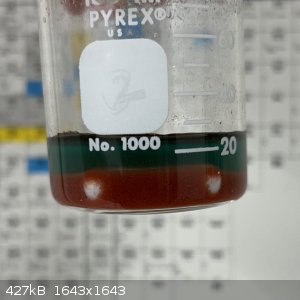
This method produces a superior product to the nickel carbonate method and is also safer as you don’t need to heat a solution of primary explosive
to high temperatures.
|
|
|
Nemo_Tenetur
Hazard to Self
Posts: 79
Registered: 13-12-2023
Location: Germany
Member Is Offline
|
|
Get a second crop!
The method described by Axt and Sir_Gawain is indeed superior. I´ve tried it in the follwing way:
0,1 mole aminoguanidine bicarbonate covered with a several ml distilled H2O, followed by an equimolar amount of 70% perchloric acid immersed in a
warm water bath to speed up dissolution, followed by 0,05 mole Ni (ClO4)2 * 6 H2O.
A dark green solution and nothing happened, not with days of patience nor with further heating (contrary to the patent claims!).
Dropwise addition with magnetic stirring of an equimolar amount (0,1 mole) of 25% aqueous ammonia gave a blue discoloration which fades immediately
with stirring. After several drops added, a dark salmon colored precipite appears. After complete addition, the flask was cooled with an external cold
water bath and further stirred .
Even after prolonged stirring and cooling, there was still a dark green supernatant solution above a generous precipitate of salmon-colored fine
crystals, which were filtered, washed with distilled water and air-dried.
The filtrate was transferred in a RBF with a magnetic stirrer, claisen distillation bridge and placed in a warm water bath. A vacuum supplied by a two
stage diaphragm pump was applied. I´ve used a warm water bath (no electric heating mantle) for two reasons.
1st, I want to avoid "hot spots" which are easy created if dried spots inside the RBF are no longer covered with the residual filtrate.
2nd, in the case of a broken RBF there is no risk of a contact with a hot heating wire which could cause an explosion. Additionally, the dangerous
mixture of a running magnetic stirrer and glass splinters (which would act as a sensitizer) is immediately quenched with a large quantity of water.
My original intention was to get some ammonium perchlorate as by-product, but to my surprise I got a second crop NAP. Probably somewhat contaminated
with ammonium perchlorate, but after cooling down, suction filtration and washing with distilled water I got an appreciable second crop NAP.
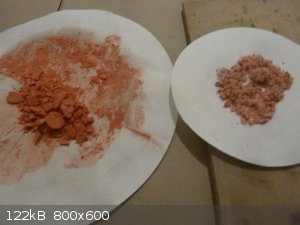
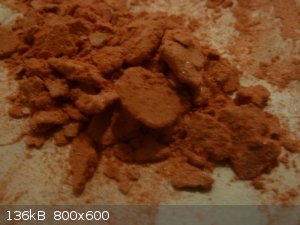
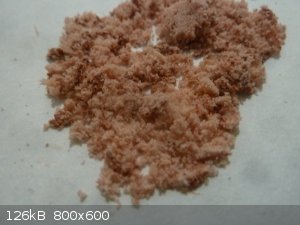
See attached pictures, large filter paper is first crop and small filter paper is second crop. Judged by the naked eye, it seems different compared
with the first crop. Even if it contains some AP as contamination, it´s definitely high energetic. After transfer of the second crop of NAP to a
fresh filter paper for further drying, I´ve hold the still wet used filter paper (which contains milligram quantities of NAP) in the blue bunsen
burner flame and got after a few seconds a considerable bang.
On the other side, a small quantity (matchhead-size) from the first crop hold with a stainless steel spatula in a blue bunsen burner flame gave a very
fast "whomp", but no bang. It seems that the very slight confinement in the porous filter paper is enough to promote ddt even in tiny amounts, whereas
completely unconfined material need a larger quantity for ddt.
Even after the second crop, the filtrate does still contain some nickel, judged by the pale green color of the filtrate. But I doubt that it is worth
to try a thirth crop.
Comments welcome.
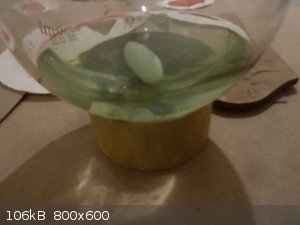
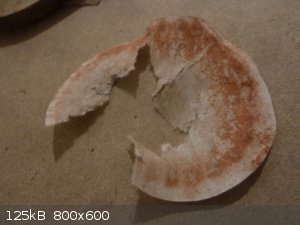
|
|
|
Sir_Gawain
National Hazard
Posts: 527
Registered: 12-10-2022
Location: southeast
Member Is Offline
|
|
Very interesting! I had also noticed that there seemed to be some nickel left in solution, it’s very good to know more can be extracted. The first
precipitated powder doesn’t usually detonate when small amounts are exposed to flame because it’s in a fine dust. Larger crystals are more prone
to instant unconfined detonation, but they’re also more shock and friction sensitive. It might be possible to increase the yield by using less water
initially or replacing the water with isopropanol.
|
|
|
dangerous amateur
Hazard to Others
Posts: 149
Registered: 8-7-2011
Member Is Offline
Mood: No Mood
|
|
Normally you'll get BASIC Nickelcarbonate when you order it...
Will this work for our needs...?
I mean for the earlier synthesis, not for the perchlorate route as I'm lacking perchloric acid...
|
|
|
| Pages:
1
..
15
16
17 |


![[*]](images/xpblue/default_icon.gif)


