| Pages:
1
2 |
Axt
National Hazard

Posts: 981
Registered: 28-1-2003
Member Is Offline
Mood: No Mood
|
|
To be honest the sinking prills surprised me too, and I still don't have an answer for it, other than a soluble product-byproduct (MNN 0.42g/100mL in
70% HNO3). I have no good means of density measurement. The prills melted at 58C too, just not quite as sharply as the needles but they were also much
bigger. The HNO3 used was an industrial cleaning acid, perfectly clear and marked 68% that is all I can say,
After doing the above I found another reference to a procedure very similar to that which I used, just a bit more convoluted they do mention that
heating beyond 60C will result in some dinitro product being formed. It's Chinese so I was copy and pasting all manner of hieroglyphics to find this,
then copy pasted it into grok. I'm not sure where the original is now (but the ref is given).
Attachment: Nitronaphthalene (chinese translation 2) (just 68 HNO3).pdf (825kB)
This file has been downloaded 47 times
[Edited on 26-2-2026 by Axt]
|
|
|
Fery
International Hazard
Posts: 1129
Registered: 27-8-2019
Location: Czechoslovakia
Member Is Offline
|
|
Thx for good paper and confirm that the 60 C is upper limit for mononitration.
If you did your experiment long time ago the 4th pic could be during washing your product with water and in that case it sunk to the bottom. Water for
washing is always colored pale yellow even only very small amounts of the product is dissolved (in scale like 20 mg per 1 L water at room temperature
and maybe like 50 mg in hot water). When your weight ratio naphthalene : HNO3 = 1:8 and initial HNO3 concentration 68% the final HNO3 would be around
60% with density around 1,37 g/cm3 in which 1-nitronaphthalene should float, density of solid 1-nitronaphthalene = 1,223 g/cm3, density of melted I do
not know but very likely less than solid, in your 3rd pic it is melted and floating in HNO3.
I suppose all methods use H2SO4 to utilize all HNO3 which is important for industry as HNO3 is more expensive than H2SO4. At small scale we prefer
simplicity (no need H2SO4) and purity (no dinitro, no unreacted naphthalene) and can neglect that 4/5 of HNO3 does not react due to big excess of the
HNO3 used when performing at scale 135,5 g HNO3 + 32,0 g naphthalene.
|
|
|
Fery
International Hazard
Posts: 1129
Registered: 27-8-2019
Location: Czechoslovakia
Member Is Offline
|
|
Recrystallization from methanol works, here how I did it. As m.p. is quite low, I did not dissolve in boiling methanol, just in temperature below m.p.
to prevent oiling out.
Crude product 44,0 g was dissolved in 200 ml of methanol after warming in 60 C water bath. Then it was let to cool down slowly in the water bath. It
crystallizes unwillingly so the solution was touched by a tip of glass rod, glass rod removed from the flask and there was tiny amount of solid
product in few seconds as methanol evaporated quickly. Tiny amount was scraped from the glass rod into the solution when its temperature fell to 30 C
and then it was let undisturbed at room temperature (previous attempt when it was stirred resulted in a mass with very tiny crystals and almost no
mother liquor). After few hours it was transferred into 10 C environment and later outside (winter time) at 0 C when it was let overnight. The next
day mother liquor was decanted as much as possible (no loses of product, crystals adhere together, weight of mother liquor 130,1 g), then crushed by
glass rod (around 20 ml of mother liquor appeared at this phase), transferred into sintered funnel, flask washed with 20 ml of fresh 0 C methanol and
added into the sinter, vacuum filtered outside at 0 C. Then 30 ml of 0 C fresh methanol added, crystals stirred with glass rod and sucked outside at 0
C using hand pump and then for few minutes inside at 20 C using water aspirator vacuum pump. Weight 30,5 g of after scraping from sinter, then air
dried in a dish for 1 day (after half a day the weight already stable without decreasing), weight of dry product 28,8 g. Mother liquor was left in
freezer at -18 C with seeding crystal for 1 day, there is a little of crystals of the product.
1-nitronaphthalene seems to be more soluble in alcohols than naphthalene, about twice better. I found only solubility of naphthalene in methanol and
ethanol, not the nitronaphthalene.
200 ml of methanol is 5 mols, extra 50 ml 1 mol, so 6 mols of methanol used totally.
Solubility of naphthalene at 0 C is 0,010 mol naphthalene + 0,990 mol methanol. 0,018 mol naphthalene + 0,982 mol ethanol.
https://srdata.nist.gov/solubility/sol_detail.aspx?sysID=59_...
https://srdata.nist.gov/solubility/sol_detail.aspx?sysID=59_...
If only 80% of naphthalene was nitrated and 20% stayed unreacted such amount of methanol is capable to keep unreacted 0,05 mol of naphthalene (from
starting 0,25 mol) dissolved. But there was no scent of unreacted naphthalene in the crude product. The scent is very nice, hard to describe. The
closest similar scent is 2-nitrophenol, but nitrophenol scent is not so good, too much artificial and chemical. The scent of 1-nitronaphthalene is
like natural and very pleasant, without anything artificial (even it does not occur in nature). It is very different from nitrobenzene or
2-nitrotoluene, much weaker and much more pleasant.
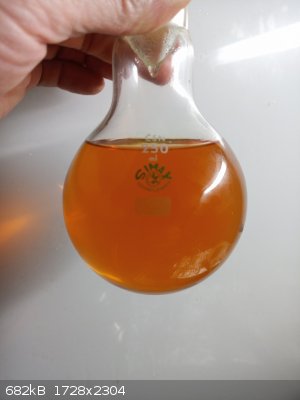
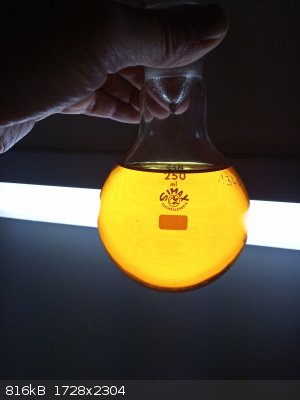
crude product dissolved in warm methanol, side light and trans light
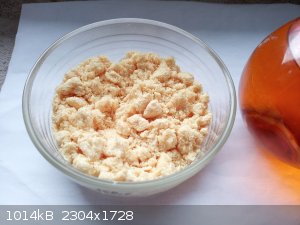
recrystallized 1-nitronaphthalene and mother liquor (there is still estimated 30-35 % of the product in the mother liquor)
[Edited on 3-3-2026 by Fery]
|
|
|
Axt
National Hazard
Posts: 981
Registered: 28-1-2003
Member Is Offline
Mood: No Mood
|
|
It looks like you got a clean product.
Generally the first place I go to for solubility data is https://chemister.ru/Databases/Chemdatabase/search-en.php You can even make requests, and he puts the data up in a month or two. Although there is
no methanol values for nitronaph.
1-Nitronaphthalene
acetic acid: very soluble [Ref.]
benzene: very soluble [Ref.]
carbon disulphide: very soluble [Ref.]
chloroform: very soluble [Ref.]
diethyl ether: very soluble [Ref.]
ethanol 95%: 31.51 (26°C) [Ref.]
ethanol 95%: 45.14 (34°C) [Ref.]
formic acid 95%: 3.44 (18.5°C) [Ref.]
nitric acid 70%: 0.28 (14°C) [Ref.]
nitric acid 70%: 0.42 (23°C) [Ref.]
sulfuric acid 70%: 0.06 (21°C) [Ref.]
sulfuric acid 70%: 0.31 (58.5°C) [Ref.]
water: 0.005 (18°C) [Ref.]
|
|
|
Fery
International Hazard
Posts: 1129
Registered: 27-8-2019
Location: Czechoslovakia
Member Is Offline
|
|
thank you Axt for valuable link and solubility data
the data for 95% ethanol - also necessary to cool down to 0 C as at 20 C the solubility is still quite high... or use diluted ethanol with water (but
then higher risk of oiling out instead of forming crystals)
interesting also nitric acid you posted - solubility is very low, but I saw few mg of crystals which formed from the spent acid after cooling down (I
posted a picture, they grew downwards from floating solidified crude product, they were much better and bigger than from methanol... pity that the
solubility in HNO3 is so low thus impractical for crystallization, maybe they were so big only thanks to that very low solubility so formed from very
diluted solution)
|
|
|
Axt
National Hazard
Posts: 981
Registered: 28-1-2003
Member Is Offline
Mood: No Mood
|
|
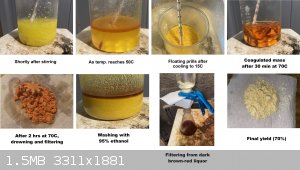
Here's naphthalene to dinitronaphthalene. The article attached is the follow-on article from the translated Chinese one above for mononitro product.
It worked fine, however the product straight from nitration was bound into orange resinous balls which was easily separated by an ethanol wash
(dinitronaphthalenes have very low solubility in 95% ethanol.) Article claims a >95% yield, mine was an honest and clean 70%. The melting point was
within the range stated in Urbanski vo. 1, pg. 427 for the commercial dinitronaphthalene (140-170C) and should primarily be a mixture of 1,5 and 1,8
isomers in a ratio of 40:60.
The article gives a simple acetone extraction to separate these isomers, 1,8 being a lot more soluble, but I haven't done this.
Attachment: Dinitronaphthalene (Chinese - Translated).pdf (4.3MB)
This file has been downloaded 21 times
|
|
|
Fery
International Hazard
Posts: 1129
Registered: 27-8-2019
Location: Czechoslovakia
Member Is Offline
|
|
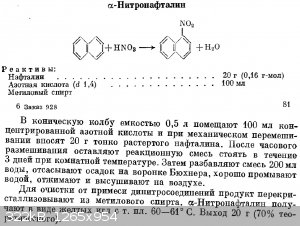
Here a method from Golodnikov - Praktikum po organiceskom sintezu 1976, pages 81-82:
Into 500 ml conical flask pour 100 ml conc. HNO3 (density 1,4 g/mL), while mechanical stirring add 20 g of powdered naphthalene. After stirring for 1
hour let it to sit for 3 days at room temperature. Pour into 200 ml of water, filter on Buchner funnel, wash well with water on filter, let to air
dry. For purification from sideproducts (dinitroderivates) recrystalize from methanol. Yellow needles, m.p. 60-61 C. Yield 20 g (70% of theoretical
amount).
[Edited on 12-3-2026 by Fery]
|
|
|
| Pages:
1
2 |
|


![[*]](images/xpblue/default_icon.gif)


