| Pages:
1
..
43
44
45
46
47 |
teodor
International Hazard

Posts: 1169
Registered: 28-6-2019
Location: Netherlands
Member Is Offline
|
|
I'm sorry if this question was already asked, this is quite a long thread. Where can I get the information regarding boiling points of AcOH/Ac2O
mixture? If it can be calculated somehow based on physical parameters of each ocompound please enlight me.
Update: already found https://doi.org/10.1021/je60012a004
Thanks who bothered to read my message.
[Edited on 20-3-2025 by teodor]
|
|
|
Waffles SS
Fighter
Posts: 1019
Registered: 7-12-2009
Member Is Offline
|
|
Quote: Originally posted by Waffles SS  | | Quote: Originally posted by clearly_not_atara | | You are correct, the patent method can work directly with AcOH. But that doesn't lower the reaction temperature of 230-260 C, meaning that you need a
pressurized setup. I thought it would be more practical to use benzoic acid at atmospheric pressure for most members. |
Thats true.
Monocarboxylic acids with a boiling point of less than 230 degrees do not lead to the formation of anhydride at atmospheric pressure,because below
this temperature, mentioned dicarboxylic acid(Phthalic acid) will not lose water and make anhydride itself.
The mechanism of this reaction is interesting for me.
I think each mole of Dicarboxylic acid react with two mole of Monocarboxylic acid and make 1 mole Asymmetric Dicarboxylic anhydride and above 230c 5
members Dicarboxylic anhydride regenerate and lead to formation of carboxylic anhydride.
|
another interesting patent about synthesis of anhydrides from dicarboxylic anhydride.
Patent suggested Glutaric anhydride but another anhydride tested too.
Attachment: US_2021347722_A1.pdf (1MB)
This file has been downloaded 236 times
Chemistry = Chem + is + Try
|
|
|
clearly_not_atara
International Hazard
Posts: 2921
Registered: 3-11-2013
Member Is Offline
Mood: Big
|
|
That sure is a fancy process. Let me see if I understand the approach here.
Normally, if you try to equilibrate acetic acid with glutaric anhydride and distill conventionally, you run into a bad case of Le Chatelier's
principle. Acetic acid is the most volatile component, so it boils first, and the equilibrium shift causes more acetic anhydride to decompose. Even if
you can make Ac2O, you can't get it out of the reaction mixture efficiently.
Instead, you use flash distillation, as a flow process, which distills the mixture faster than the equilibrium can establish itself. This allows you
to separate a fraction containing primarily Ac2O and AcOH and a second fraction containing primarily glutaric acid and its anhydride. These can then
be separated by conventional methods. Everything is reused except acetic acid, so the economics are basically optimal.
This is pretty cool, but I don't have any idea how to set up a flash distillation on the tabletop. In principle, it shouldn't be harder than a ketene
lamp, and you could definitely make a whole lot of Ac2O if you actually built this thing.
|
|
|
MrDoctor
Hazard to Others
Posts: 249
Registered: 5-7-2022
Member Is Offline
|
|
based on what i read, some sort of complex is forming that decomposes to produce a low percentage of anhydride, or perhaps not but, ultimately
yielding a low output of anhydride per individual step or batch, and what seems to be important is the use of a vacuum sufficiently hard enough to
prevent the acetic anhydride from hydrolyzing, so this follows a similar mechanic that was mentioned at some earlier point in this thread where
phosphoric acid of some dehydrated state was suggested, if only one could overcome the issue of the anhydride forming alongside water under conditions
that would rapidly cause it to hydrolyze back together before any sort of separation could occur.
read [0046] as well as the example process given right under the table.
the mixture of acetic acid and the glutaric anhydride are heated together for 15 minutes before being distilled under a strong vacuum, i would
probably describe this as a flash boil. What isnt clear to me is how long the two need to remain in contact.
I do also have an idea for how one might run this continuously, vaguely. what immediately comes to mind is the idea of putting a chunk of glass frit
inside a tube and then melting the tube and clamping it around the frit. using a strong vacuum line if one were to draw up the "transanhydrization"
mixture, at say, 100C, it would flow through the frit very slowly, and boil aggressively as it reaches all the way through. furthermore it would be
trivial to use a heater of some sort to maintain 100C in the tube itself. the image i thought of was the capillary valve in an air conditioning
system, where theres high pressure on one side and low on the other, using a capillary to allow a differential.
If silicone tubing is compatible with acetic acid and the anhydride, you could move the fluid around from reactor to reactor using peristaltic pumps
to produce the series of reactions it asks for to get up to 20% or so conversion.
|
|
|
greenlight
National Hazard
Posts: 796
Registered: 3-11-2014
Member Is Offline
Mood: Energetic
|
|
Phosphorus pentoxide dehydration final attempt
I decided to attempt dehydration of glacial acetic acid with phosphorus pentoxide one more time before putting it to bed for good.
This time I opted to use an inert atmosphere within the reaction flask to exclude as much water vapor as possible in case that was the cause of the
tar.
I used 50 ml of glacial acetic acid in a 250ml three neck round bottom flask surrounded by a salt-ice bath with one neck just stoppered for pentoxide
addition. The central neck was fitted with an overhead stirrer with PTFE paddle and joint while the third neck had a gas flow adapter hooked up to an
argon gas bottle by PVC tubing. The flask was purged of air and stirring started. For ever addition of phosphorus pentoxide, the gas flow was
started and the gas inlet opened before opening the first stopper and rapidly deploying two small heaped spatulas of the dehydrating agent. Then the
stopper was placed back into the socket before closing the inlet and turning the argon off to ensure an oxygen free environment.
This seemed to be working quite well as only a small amount of gunk was present in the reaction mixture and it only acquired a very pale yellow
colour. I don't know how much pentoxide was added as I had no way of weighing it but it was approximately ~50 grams. The temperature was kept low at
around 10 degrees the entire time.
After this, argon was not utilised further and the stirrer was swapped out for a liebig condenser. Gentle heat was applied which was increased slowly
to a boil from a heating mantle which now caused darkening of the mixture. Reflux was continued for 1 hour whereafter a dark brown reaction mixture
now resulted.
An attempt was made to distill and sure enough unreacted glacial acetic acid came off around 117 to 120 degrees C (25 ml) before the temperature
started to climb again. Excitement increased as the temperature rose to 130 then to 132 then 134.5 aaaannnddd nothing. Temperature dropped all the
way back down to 110 °C and the reaction flask was now foaming tar again.
So, frustratingly, even when babied, this reaction is completely useless.
This one reagent is giving me the hardest time out of any I have had to synthesise and I am seriously considering the ketene lamp after this despite
the insane toxicity and fire/explosion hazard if air is in the apparatus.
Oh well, back to the drawing board again it is.
[Edited on 18-6-2025 by greenlight]
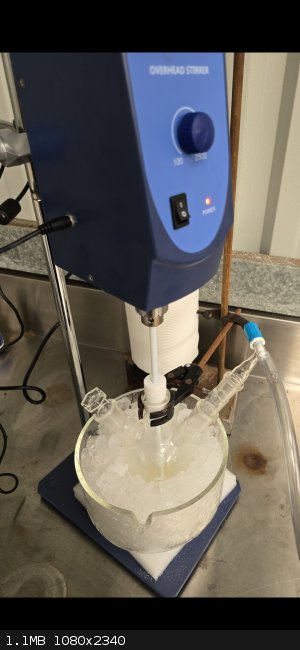
|
|
|
Fery
International Hazard
Posts: 1119
Registered: 27-8-2019
Location: Czechoslovakia
Member Is Offline
|
|
Hi greenlight, even in case if acetic anhydride was produced it could react with P4O10
https://www.sciencemadness.org/whisper/viewthread.php?tid=15...
P4O10 has also such a problem that if water is produced in a reaction, its surface gets covered with a layer of polyphosphoric acid which prevents
further reaction. For the above reaction (acetic anhydride as the reactant and 2,6-dimethyl-gamma-pyrone as a product) I had to dissolve P4O10 in
H3PO4 to produce polyphopshoric acid. That polyphosphoric acid was very reactive and my reaction mixture got quickly black color and a lot of tar at
the end. You got only pale yellow content in your reaction flask.
|
|
|
greenlight
National Hazard
Posts: 796
Registered: 3-11-2014
Member Is Offline
Mood: Energetic
|
|
Hello Fery,
Interesting, so your saying that if acetic anhydride is produced, it will undergo further reaction with the phosphorus pentoxide?
Furthermore, even with every effort to exclude any water from the reaction, it can be formed in situ?
|
|
|
clearly_not_atara
International Hazard
Posts: 2921
Registered: 3-11-2013
Member Is Offline
Mood: Big
|
|
If you are determined to try a polyphosphoric method I would consider gassing HCl through a solution of NaPO3 in AcOH, assuming that it will actually
dissolve. The volatility of AcCl (bp 52 C) might allow it to boil off at lower temperatures where Ac2O would decompose before boiling. But the
volatility of AcCl also means that it is more dangerous to handle. Optimal reaction temperature is probably around 50-60 C, but it may be difficult to
control. Scrubbing the exhaust will be an issue.
|
|
|
clearly_not_atara
International Hazard
Posts: 2921
Registered: 3-11-2013
Member Is Offline
Mood: Big
|
|
And to my great surprise:
https://orgsyn.org/demo.aspx?prep=CV1P0091 | Quote: | | Benzoic anhydride can be prepared [...] from benzoic acid and phosphorus in benzene solution by shaking with air or
oxygen;8 |
And so it was that the reaction pursued for 15 years and thought impossible
turned up in Organic Syntheses of all places, by a completely unexpected methodology.
The citation 8 is: Rankov, Ann. univ. Sofia, II, Faculté phys.-math., Livre 2, 33, 221 (1937) [C. A. 32, 3335 (1938)]. -- this is very hard to track
down! It looks like any attempt at this method will require improvisation.
Obviously, benzoic anhydride is not acetic anhydride, but getting the one from the other ought to be pretty simple. It is of course convenient iff you
have phosphorus 
[Edited on 5-8-2025 by clearly_not_atara]
|
|
|
MrDoctor
Hazard to Others
Posts: 249
Registered: 5-7-2022
Member Is Offline
|
|
if anyone wanted to try that method listed earlier using dicarboxylic acid anhydrides to dehydrate acetic acid to the anhydride, included in the
results were successful instances of using polyphosphoric acid, with similar yields, so, it might be worth trying that process from the patent,
aggressively vacuum distilling the mixture after a period of heating/stirring to get seperation.
It occured to me that since acetic anhydrides BP is higher than acid, and this process only produces a small amount each time, maybe the reason rapid
vacuum boiling is used is because under high temperatures it reverses moderately quickly? wheras slowly fractionally distilling it would result in it
having a huge time spent getting exposed to heat and the hydrated dicarboxylic acid, with a decreasing amount of acetic acid solvating things, so, the
reason that during each pass only 2-5% converts is because perhaps thats all steam distills through before it reverses?
So i have a question about that for when i give it a try, is there anything known to azeotrope with acetic anhydride but not acetic acid? or
otherwise, anyone know if theres a co-solvent that might help tip the scales to improve how quickly the anhydride can be seperated from the solution
so it doesnt hydrolyze again so easily?
the most i could find was azeotropes, for toluene, benzene and cyclohexane, but acetic acid forms an even stronger azeotrope with them so it probably
wont help, and toluene was tested in the patent research table. Then theres non-azeotropes, for which all i could find was isopropyl ethers and
esters, though i suspect they are the same for acetic acid, similar substances tend to be that way when it comes to just, co-distilling.
Another thing, to anyone having difficulty sourcing glutaric acid to give that patent a try, i didnt save it but there is an inconvenient way to get
it from glutamic acid if deaminated a particular way, but also, there is a commercial product known as "dibasic ester", a sometimes cheap solvent,
made from the esters of succinic and glutaric acid. otherwise glutaric acid is a rather niche product it seems that is hard to find, even expanding my
net internationally i couldnt easily find any for sale outside of scalper-rates, or places selling small amounts of analysis grade stuff asking for
$30/g sold by the milligram.
|
|
|
greenlight
National Hazard
Posts: 796
Registered: 3-11-2014
Member Is Offline
Mood: Energetic
|
|
I just completed a second attempt at the follwing:
1. Benzyl alcohol to benzaldehyde via oxidation with dilute nitric acid.
2. Benzaldehyde to benzoyl chloride by direct chlorination with sulfur catalyst.
3. Benzoyl chloride to acetyl chloride by reaction with glacial acetic acid.
As a test run, 30ml of benzoyl chloride was placed into a 100ml round bottom flask with 20 ml of glacial acetic acid which had been dried by
distillation over phosphorus pentoxide. A fractional distillation apparatus was set up with an ice cooled liebig condesner and heat applied from a
heating mantle. The recovery was extremely slow with only a drop coming over every minute or so.
The product is definitely acetyl chloride due to still head temp being around 50°C and the distillate fumes acidic vapours upon exposure to air.
The only problem is the yield was only about ~5 ml which corresponds to about 29%.
So, does the reaction of benzoyl chloride and glacial acetic acid produce acetyl chloride? Yes. Is it beneficially viable at the moment? No.
Maybe purifying the benzoyl chloride with further distillation would improve things.
|
|
|
clearly_not_atara
International Hazard
Posts: 2921
Registered: 3-11-2013
Member Is Offline
Mood: Big
|
|
| Quote: | | Another thing, to anyone having difficulty sourcing glutaric acid to give that patent a try, i didnt save it but there is an inconvenient way to get
it from glutamic acid if deaminated a particular way, but also, there is a commercial product known as "dibasic ester", a sometimes cheap solvent,
made from the esters of succinic and glutaric acid. otherwise glutaric acid is a rather niche product it seems that is hard to find, even expanding my
net internationally i couldnt easily find any for sale outside of scalper-rates, or places selling small |
I looked into glutaric acid and from all indications it doesn't cyclize as easily as diacids that form 5-membered rings. I wondered if you could just
use citric acid to form itaconic and citraconic anhydrides in situ. Otherwise you would need phthalic acid.
The oxidation of alpha-phellandrene in eucalyptus oil should produce 2-isopropylsuccinic acid, which would also be a strong contender as an effective
high-boiling catalyst:
https://en.wikipedia.org/wiki/Phellandrene
It would probably be obtained by oxidizing crude euc. oil and then precipitating the diacid products as their calcium salts. This is still work,
unfortunately.
|
|
|
MrDoctor
Hazard to Others
Posts: 249
Registered: 5-7-2022
Member Is Offline
|
|
| Quote: Originally posted by clearly_not_atara | | Quote: | | Another thing, to anyone having difficulty sourcing glutaric acid to give that patent a try, i didnt save it but there is an inconvenient way to get
it from glutamic acid if deaminated a particular way, but also, there is a commercial product known as "dibasic ester", a sometimes cheap solvent,
made from the esters of succinic and glutaric acid. otherwise glutaric acid is a rather niche product it seems that is hard to find, even expanding my
net internationally i couldnt easily find any for sale outside of scalper-rates, or places selling small |
I looked into glutaric acid and from all indications it doesn't cyclize as easily as diacids that form 5-membered rings. I wondered if you could just
use citric acid to form itaconic and citraconic anhydrides in situ. Otherwise you would need phthalic acid.
The oxidation of alpha-phellandrene in eucalyptus oil should produce 2-isopropylsuccinic acid, which would also be a strong contender as an effective
high-boiling catalyst:
https://en.wikipedia.org/wiki/Phellandrene
It would probably be obtained by oxidizing crude euc. oil and then precipitating the diacid products as their calcium salts. This is still work,
unfortunately. |
do you have some sort of source for this idea, that glutaric anhydride cant simply be formed through thermal dehydration? its kind of a central point
of the patent that water can just be distilled off and the anhydride regenerated with little effort or the consumption of non-reusable commercial
dehydrating agents.
Also, with citric acid, ill look into that. i recently acquired a large, literal lump of glutaric anhydride so ill see how that works out, both,
making acetic anhydride but also, how readily it is regenerated. if its not a load of crock, ill try citric acid derivatives because, thats just
insanely accessible to anyone with lemon technology.
|
|
|
SHADYCHASE54
Hazard to Others
Posts: 151
Registered: 16-12-2010
Location: CaNaDay!
Member Is Offline
Mood: No Mood
|
|
Has anyone ever tried reacting red phosphorus with chlorine in glacial acetic acid and distilling off the acetyl chloride? Seems like a potentially
simple small scale prep that would give easy access to an acetylating agent. I've never tried it but if you have a good fumehood it should work. Just
a thought I probably read it somewhere?
|
|
|
chempyre235
Hazard to Others
Posts: 207
Registered: 21-10-2024
Location: Between Nb and Tc
Member Is Offline
Mood: Quite distracted
|
|
| Quote: Originally posted by MrDoctor | | Quote: Originally posted by clearly_not_atara | | Quote: | | Another thing, to anyone having difficulty sourcing glutaric acid to give that patent a try, i didnt save it but there is an inconvenient way to get
it from glutamic acid if deaminated a particular way, but also, there is a commercial product known as "dibasic ester", a sometimes cheap solvent,
made from the esters of succinic and glutaric acid. otherwise glutaric acid is a rather niche product it seems that is hard to find, even expanding my
net internationally i couldnt easily find any for sale outside of scalper-rates, or places selling small |
I looked into glutaric acid and from all indications it doesn't cyclize as easily as diacids that form 5-membered rings. I wondered if you could just
use citric acid to form itaconic and citraconic anhydrides in situ. Otherwise you would need phthalic acid.
The oxidation of alpha-phellandrene in eucalyptus oil should produce 2-isopropylsuccinic acid, which would also be a strong contender as an effective
high-boiling catalyst:
https://en.wikipedia.org/wiki/Phellandrene
It would probably be obtained by oxidizing crude euc. oil and then precipitating the diacid products as their calcium salts. This is still work,
unfortunately. |
do you have some sort of source for this idea, that glutaric anhydride cant simply be formed through thermal dehydration? its kind of a central point
of the patent that water can just be distilled off and the anhydride regenerated with little effort or the consumption of non-reusable commercial
dehydrating agents.
Also, with citric acid, ill look into that. i recently acquired a large, literal lump of glutaric anhydride so ill see how that works out, both,
making acetic anhydride but also, how readily it is regenerated. if its not a load of crock, ill try citric acid derivatives because, thats just
insanely accessible to anyone with lemon technology. |
Citraconic anhydride is the favored product over itaconate in the dry distillation of citric acid. Citraconic anhydride is favored over the free acid,
and is a liquid at room temperature. Citric acid begins to decompose to its pyrocitrate derivatives above 175°C.
https://en.wikipedia.org/wiki/Citric_acid
https://en.wikipedia.org/wiki/Citraconic_acid
"However beautiful the strategy, you should occasionally look at the results." -Winston Churchill
"I weep at the sight of flaming acetic anhydride." -@Madscientist
"...the elements shall melt with fervent heat..." -2 Peter 3:10
|
|
|
bnull
National Hazard
Posts: 993
Registered: 15-1-2024
Location: East Woods
Member Is Offline
Mood: Fecking annoyed
|
|
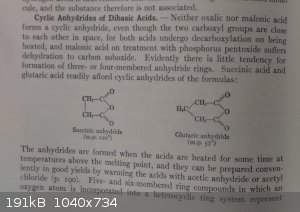
Fieser & Fieser's Organic Chemistry, 2nd edition, p.312:
|
|
|
clearly_not_atara
International Hazard
Posts: 2921
Registered: 3-11-2013
Member Is Offline
Mood: Big
|
|
Glutaric it is!
|
|
|
MrDoctor
Hazard to Others
Posts: 249
Registered: 5-7-2022
Member Is Offline
|
|
ill give this a try at some point in the next few weeks or so. Assuming it works, realistically im expecting a yield cap of 5-10% at best in the
solution at the end if what it said about re-using the flash-distillate is correct, is there a better way to seperate acetic acid and anhydride than
just fractional distillation? or rather, to quickly aproximate the content, when said content is probably 2-3%, in 100ml. i could see this working
rather nicely as a continuous or automated process, but as batches, in regular glassware, its going to be a lot of work just to figure out which
variables reliably impact the outcome and dial the right settings in. Assuming 20% final concentration is correct, thats not at all unreasonable to
just purify by distillation with a little overshoot to be safe and directly produce useable acetic anhydride, but that requires making an assumption,
which is that for some reason, the acetic anhydride WONT react as literature says, with glutaric acid, dehydrating it. Patents say all sorts of things
and use a rather vague language that makes it hard to tell if the person writing it even understood what the heck they were even doing, which makes
someone like me, who also doesnt know what im doing, feel uneasy about sinking a whole weekend into proofing it.
|
|
|
clearly_not_atara
International Hazard
Posts: 2921
Registered: 3-11-2013
Member Is Offline
Mood: Big
|
|
Acetic acid, bp 118, forms an azeotrope with toluene, bp 110, which is 72/28 toluene/AcOH (more simply, 5 parts toluene to 2 parts acetic acid) and
has a bp of 105 C. This might be helpful, though I'm not certain.
[Edited on 15-8-2025 by clearly_not_atara]
|
|
|
MrDoctor
Hazard to Others
Posts: 249
Registered: 5-7-2022
Member Is Offline
|
|
| Quote: Originally posted by clearly_not_atara | Acetic acid, bp 118, forms an azeotrope with toluene, bp 110, which is 72/28 toluene/AcOH (more simply, 5 parts toluene to 2 parts acetic acid) and
has a bp of 105 C. This might be helpful, though I'm not certain.
[Edited on 15-8-2025 by clearly_not_atara] |
The idea is to remove the anhydride from the acid so as not to have to distill all the acid every time.
Anyway toluene also forms an azeotrope with acetic anhydride from which the anhydride cannot be seperated at concentrations under 8%
I dont know what the affinity differences are for acetic acid vs toluene for dissolving the anhydride, but either way, including it complicates things
and im just talking about a way to quickly determine the yield experimentally, since this system can vary a bit from 2-10% depending on the
temperature
That being said i revisited the patent, and noticed entry 26,27,28 "sulfobenzoic" acid/anhydride.
if this is the 2 or ortho kind, that one can obtain by hydrolysis of saccharin by HCl, it should be noted that as opposed to the peak conversion of
16% glutaric anhydride and converting 10% of the acetic acid to anhydride, the sulfobenzoic anhydride seems to dehydrate 30-37% of the acetic acid,
hydrating 50-65% to its acid, i am not certain if or not the distillate can be cycled through again, 30% anhydride may be too much and it could just
dehydrate the sulfobenzoic acid, wheras glutaric i think is good until spent, but still.
If that sulfobenzoic anhydride is indeed the one easily made from artificial sweetener, im definitely going to try making some and testing it out. As
far as i can tell its also infinitely regenerable and doesnt decompose if its not dissolved in water.
|
|
|
Waffles SS
Fighter
Posts: 1019
Registered: 7-12-2009
Member Is Offline
|
|
One of interesting and easiest method for separation acetic anhydride from acetic acid is chilling to -60 C.
At this temp mixture solidified and by heating gradually anhydride separate easily. (melting point of anhydride is lower than acetic acid)
I did this method by dry ice many times and reach more than 85% purity of anhydride by repeating this procedure three times.
Chemistry = Chem + is + Try
|
|
|
MrDoctor
Hazard to Others
Posts: 249
Registered: 5-7-2022
Member Is Offline
|
|
| Quote: Originally posted by Waffles SS | One of interesting and easiest method for separation acetic anhydride from acetic acid is chilling to -60 C.
At this temp mixture solidified and by heating gradually anhydride separate easily. (melting point of anhydride is lower than acetic acid)
I did this method by dry ice many times and reach more than 85% purity of anhydride by repeating this procedure three times. |
that is certainly interesting. it makes me wonder if adding an immiscible solvent would then push all the anhydride into that solvent, some reactions
push on like that because if the anhydride has somewhere to go, though i think the force there tends to be the potential in the phase change and that
usually is favored in the other direction, but anyway, that might allow the acetic acid to begin freezing at much lower temps if the anhydride is
whats keeping the acid from crystalizing and thus concentrating the anhydride further, but this assumes that from the get go that the solvent in
question is at least somewhat effective at pulling anhydride out, and on top of that either also doesnt form an azeotrope, or, would be extracted very
quick and easily to a high degree of efficiency in this case, because then what could be done is, the starting and finish weight could be measured to
see how much weight change occured in either the acid or the solvent after extraction.
|
|
|
Waffles SS
Fighter
Posts: 1019
Registered: 7-12-2009
Member Is Offline
|
|
| Quote: Originally posted by MrDoctor |
that is certainly interesting. it makes me wonder if adding an immiscible solvent would then push all the anhydride into that solvent, some reactions
push on like that because if the anhydride has somewhere to go, though i think the force there tends to be the potential in the phase change and that
usually is favored in the other direction, but anyway, that might allow the acetic acid to begin freezing at much lower temps if the anhydride is
whats keeping the acid from crystalizing and thus concentrating the anhydride further, but this assumes that from the get go that the solvent in
question is at least somewhat effective at pulling anhydride out, and on top of that either also doesnt form an azeotrope, or, would be extracted very
quick and easily to a high degree of efficiency in this case, because then what could be done is, the starting and finish weight could be measured to
see how much weight change occured in either the acid or the solvent after extraction. |
Related patent.
Attachment: US1941951.pdf (347kB)
This file has been downloaded 112 times
[Edited on 18-8-2025 by Waffles SS]
Chemistry = Chem + is + Try
|
|
|
MrDoctor
Hazard to Others
Posts: 249
Registered: 5-7-2022
Member Is Offline
|
|
damn, if i read that patent right it seems like nothing useful can be done until -40C at best, even with what i was saying, although i think they only
tested solvents that dissolve both the acid and the anhydride and only with respects to keeping water out. but it means if there is such a solvent,
its not those.
Maybe at some point though ill give something a try, and see what happens if i mix -20C thoroughly frozen but crushed up, glacial acetic acid, with a
-20C mixture of acid/anhydride, then put them together in the freezer and see what happens when additional solvents are introduced, if perhaps the
existence of already solid acetic acid helps things along, since less energy is needed to precipitate onto an existing solid of that kind than to do
so spontaneously from liquid
|
|
|
Waffles SS
Fighter
Posts: 1019
Registered: 7-12-2009
Member Is Offline
|
|
| Quote: Originally posted by MrDoctor | damn, if i read that patent right it seems like nothing useful can be done until -40C at best, even with what i was saying, although i think they only
tested solvents that dissolve both the acid and the anhydride and only with respects to keeping water out. but it means if there is such a solvent,
its not those.
Maybe at some point though ill give something a try, and see what happens if i mix -20C thoroughly frozen but crushed up, glacial acetic acid, with a
-20C mixture of acid/anhydride, then put them together in the freezer and see what happens when additional solvents are introduced, if perhaps the
existence of already solid acetic acid helps things along, since less energy is needed to precipitate onto an existing solid of that kind than to do
so spontaneously from liquid
|
If you have access to dry ice then lowering temp is not difficult (dry ice temp is ~-70c)
Also preparing dry ice is simple if you have CO2 gas cylinder
Anyway I want to introduce another interesting method for synthesis carboxylic acid anhydride by electrolysis.
Electrolysis by graphite anode and steel cathode of mixture:
Carboxylic acid + acetonitrile + catalyst (potassium thiocyanate) make anhydride
Attachment: 10.1002@open.202200059.pdf (1.6MB)
This file has been downloaded 144 times
Attachment: open202200059-sup-0001-misc_information.pdf (3.2MB)
This file has been downloaded 139 times
[Edited on 18-8-2025 by Waffles SS]
Chemistry = Chem + is + Try
|
|
|
| Pages:
1
..
43
44
45
46
47 |



![[*]](images/xpblue/default_icon.gif)


